
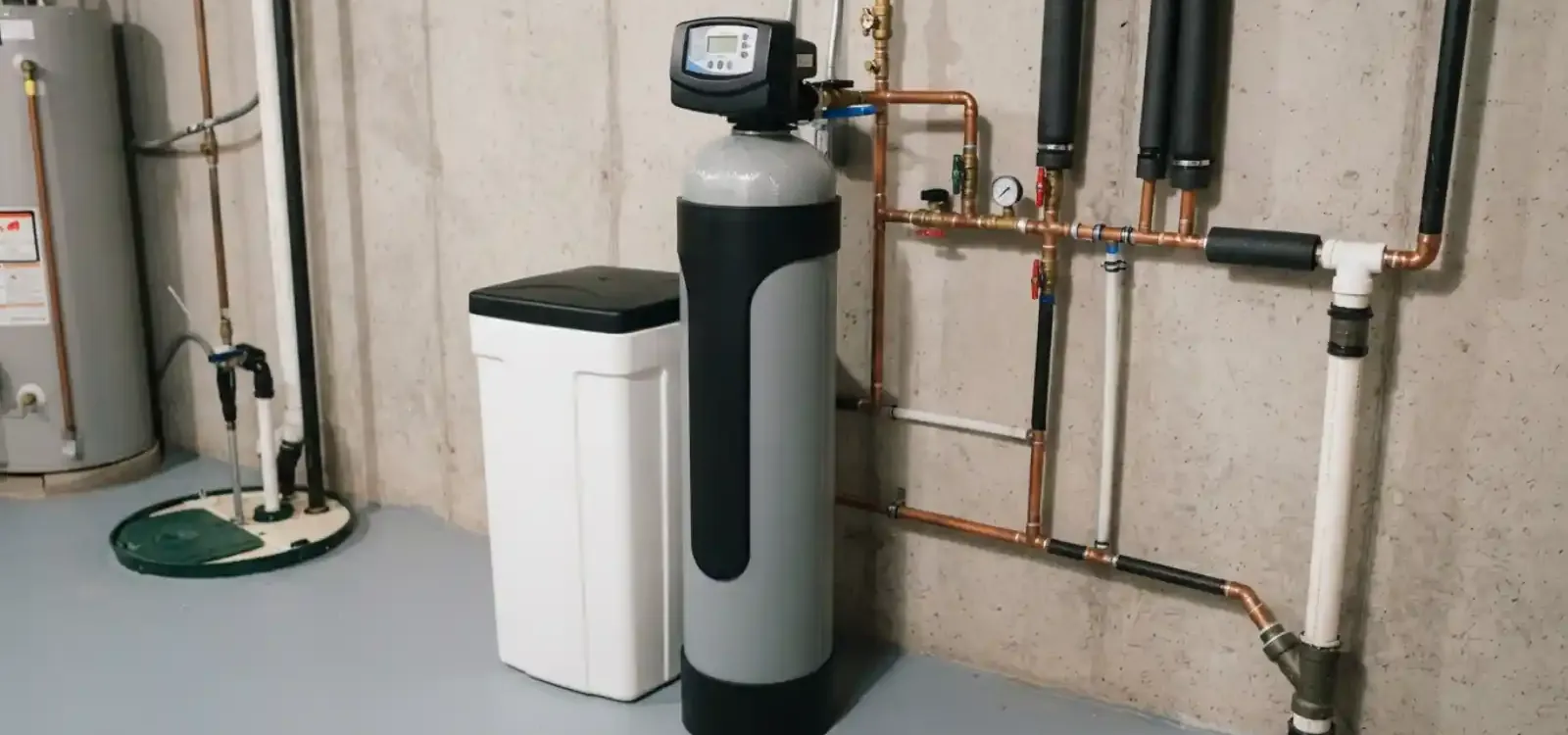
Water softener and filtration work in Willoughby, OH begins with a plain question: what are you trying to fix? Scale on faucets and a chalky film on glass point to hardness, which a softener handles. A chlorine smell or taste points to a carbon filter. They are different tools, and a good installation uses the right one.
A water softener is a tank of resin beads that swaps calcium and magnesium in hard water for sodium or potassium. A filter catches particles or adsorbs certain chemicals. Neither one is a catch-all, and this page says where each stops.
What comes out of a Willoughby tap
Willoughby, Eastlake, Willowick, Wickliffe and Willoughby Hills buy water from the Lake County Department of Utilities West Sub-District. It is treated at the Aquarius Water Treatment Facility in Willoughby and drawn from an offshore Lake Erie intake. Mentor is different, since its water comes from Aqua Ohio's Mentor system, also from Lake Erie.
That matters before you buy anything. A treatment plant already removes particles and disinfects the water, so most filter purchases are about taste, smell or scale at your own tap rather than a gap in the utility's work. Know which supplier you have, because the reports and phone numbers differ.
What the 2025 Consumer Confidence Report says
The West Sub-District's 2025 report lists fluoride at 1.07 ppm, total chlorine at 1.36 ppm with a range of 1.21 to 1.50, and maximum turbidity of 0.13 NTU. Lead was below 2.0 ppb at the 90th percentile, and none of the 30 homes sampled went over the 15 ppb action level. Copper measured 0.078 ppm, also with no homes over its action level.
The chlorine figure is why many people notice a pool-like smell in a glass of tap water. A carbon filter is the standard tool for that. We read these numbers as reference points only. We do not make health claims, and anyone with a medical concern about water should ask their doctor and the utility.
Talk it through before buying
Call (440) 468-0237 with the model you are considering or the symptom you want gone.
The hardness number nobody publishes
Lake County's report does not list a hardness figure, so call the utility lab at 440-918-3420 or test your own tap. A drop-in test strip is rough, but a lab or a water-test kit gives a number you can size a softener against.
For context only, Cleveland Water, which also treats Lake Erie water, reports about 6.6 grains per gallon (113 ppm), which is a neighboring utility's number, not a Willoughby reading. A grain is a unit of hardness, and a softener is sized by grains it can remove between regenerations. Do not buy a softener by guessing.
Softener, carbon filter or reverse osmosis
Each system answers a different complaint, and none of them replaces the others.
| System | Best for | Where it falls short |
|---|---|---|
| Salt-based softener | Scale on fixtures, spotted glasses, soap that will not lather | Does not filter chlorine or particles and adds a brine drain to the install |
| Whole-house carbon filter | Chlorine taste and smell at every tap | Does not soften water, and the cartridge needs replacement on a schedule |
| Sediment filter | Sand, rust flakes and silt | Does not touch dissolved minerals or chemicals |
| Under-sink reverse osmosis | Drinking and cooking water at one faucet | Slow flow, a drain line, wasted water and a separate tap |
| Carbon block at the sink | Taste and smell at one tap | Limited capacity, and it must be changed on time |
Look for NSF/ANSI listing on the package for the specific claim you care about, such as chlorine taste or lead reduction.
What filters and softeners will not remove
A softener does not remove lead, chlorine, bacteria or the particles in a sediment filter's job. A carbon filter does not soften the water, and a standard filter does not remove everything on a utility test report. The marketing on the box and the NSF listing are not always the same thing.
If you are worried about lead, the first step is finding out whether your service line has any. Lake County Utilities publishes an address search map at lead-service-line-inventory-lcdugis.hub.arcgis.com. A filter does not fix a lead service line. When one is found, water line replacement is the permanent answer, and any filter should be rated for lead by its NSF listing.
How a softener install goes
- 1
Pick the location
A softener wants a floor drain or standpipe nearby, a power outlet and room for a salt bin. Basements and utility closets are the usual spots.
- 2
Tie into the main supply
The unit is plumbed after the main shut-off and before the water heater. A bypass valve lets you isolate it for service.
- 3
Run the drain
Regeneration flushes salty water out through a drain line. It needs an air gap so wastewater cannot flow back into the unit.
- 4
Set hardness and regeneration
The control head is programmed with your hardness reading and household size. This is why a measured number matters.
- 5
Pressure and leak check
We open the valves slowly, purge air, check every fitting and cycle the unit through regeneration.
Service for softeners you already own
A unit that has stopped working is often a simple fault. The common ones are a brine tank bridged with hard salt, a clogged injector, a worn control valve or a stuck bypass. A cut or crimped drain line during a remodel also stops regeneration, and so does a power supply that was unplugged.
Bring us the brand and model, and tell us when it last made soft water. We can say on the phone whether it is worth repairing or replacing. Older tanks that show leaks around the valve base are often replacement jobs rather than repairs, and plumbing installation covers hooking up a replacement.
Permits and the Lake County difference
Lake County Building Department lists a water softener on its permit schedule for communities it serves, including Willoughby Hills and Willowick. Inside the City of Willoughby, plumbing permits come from the city's Division of Building Inspection, so we confirm the right office for your address before the job. Mentor homeowners can ask the City of Mentor building division.
If your house is on a private well, the rules differ and lab testing becomes more important. Our work stays with the plumbing. For a water analysis of a well, use a certified lab, then bring us the results and we will size the equipment. Nearby cities such as Mentor have their own water supplier, so a neighbor's setup may not suit your home.
What shapes the price of a softener or filter system
System choice and install conditions set the price far more than the brand name. We give a clear price before work starts, and a description of your water, your plumbing and your goals is enough to start.
System size and type
A softener sized for a family of five with high hardness holds more resin than a small unit, and a multi-stage filter costs more than a single cartridge.
Location and plumbing
A utility room with a drain beside the main is quick. A far corner of the basement needs longer runs.
Drain and electrical needs
A softener needs a drain and power. If neither is nearby, the job may need a pump or an electrician.
Water quality
A measured hardness reading or a lab result lets us size correctly instead of over-building.
Ongoing costs
Salt, cartridges and membranes are recurring expenses, so ask about them before you choose.
Insurance note. Homeowners insurance does not pay for a softener or filter bought as an upgrade, and water damage from a failed unit is usually covered only when the leak is sudden, so call for your number.
Water softener and filtration questions
Lake County's report does not list a hardness figure, so we do not quote one. Call the utility lab at 440-918-3420 or test your tap. For context only, Cleveland Water, which also treats Lake Erie water, reports about 6.6 grains per gallon (113 ppm), which is a neighboring utility's number, not a Willoughby reading.
Yes, installation of softeners, carbon filters and under-sink reverse osmosis, plus service on existing units. Tell us the brand and the symptom. If you already bought the tanks, bring the model number so we can check the connections and bypass before we plan the job.
No. A softener targets calcium and magnesium. Chlorine taste and smell are handled by a carbon filter. The utility's 2025 report lists total chlorine at 1.36 ppm, so many homes notice it. If that is your complaint, a whole-house carbon filter or a sink filter is the better choice.
Only a filter certified for lead reduction on its NSF listing does that, and it has to be maintained. The better step is checking your service line on the Lake County Utilities inventory map. We do not make health claims, so talk to a doctor about medical concerns.
Often yes. Lake County Building Department lists softeners on its permit schedule for the communities it serves. Inside Willoughby, ask the city's building inspection division, and Mentor uses its own building division. We check the right office for your address.
In most cases, yes. Brine tank bridging, clogged injectors, worn valves and drain line problems can be fixed. Tell us the make and model. For a basic call, we will say whether repair or replacement makes more sense. Our 24/7 line handles emergencies, such as a leaking tank.