
A water heater that quits on a January morning in Willoughby, OH is more than an annoyance. Our crew handles water heater repair on gas and electric tanks, and the emergency line runs 24/7. Same-day appointments are available when the schedule allows.
Repair means finding the one failed part and replacing it, not guessing. Thermocouples, flame sensors, heating elements, thermostats, gas valves and drain valves fail one at a time, and most are cheaper to fix than the tank is to replace. A tank that is leaking from its shell is a different story, and we say so plainly.
While you wait for us, check the floor first. Water spreading from the base means shutting off the cold supply and the power or gas control right away, as the steps below explain.
When a leaking water heater is an emergency
Water coming from the top of the tank, from a pipe connection or from the drain valve is often a repair. Water coming from the bottom jacket of the tank, or pooling steadily from beneath it, usually means the steel shell has rusted through. That cannot be patched.
Treat any of these as an emergency: water spreading across the floor, a hot or scorched smell, a tripped breaker near the heater, or water reaching a furnace, panel or finished room. Call the 24/7 line and keep everyone out of standing water near electrical equipment.
If you smell gas at any point, do not touch switches or look for the source. Leave the building and call the gas utility or 911 from outside. Then call us once the utility says the house is safe.
What to do before the technician arrives
These steps limit damage and keep you safe. Stop at any step that feels unsafe.
Shut the cold supply
Find the valve on the cold pipe entering the top of the tank and turn it clockwise until it stops. If the valve spins freely or will not close, shut the main at the meter or where the line enters the house.
Cut the fuel or power
For a gas tank, turn the gas control knob to OFF or the pilot setting your label shows. For an electric tank, switch off its breaker. Never leave an electric element energized in a tank that is losing water.
Leave the relief valve alone
The temperature and pressure relief valve and its discharge pipe are safety parts. Do not cap, plug or tighten them to stop a drip, and do not move the pipe. A dripping relief valve is a symptom we diagnose on site.
Limit the water
Move stored items off the floor, put a bucket or wet vac under a slow drip and open a hot tap upstairs to relieve pressure. Photograph the damage and the tank label for your insurance file.
No hot water tonight?
Call the 24/7 line and describe the symptoms, and we will tell you whether it sounds like a repair.
Symptom, likely cause and the usual fix
Match what you see to the likely fault. Your technician still confirms with a meter or gauge before replacing anything.
| What you notice | Gas tank, likely cause | Electric tank, likely cause |
|---|---|---|
| No hot water at all | Pilot out, worn thermocouple, or failed gas control valve | Tripped breaker, tripped high-limit reset, or both elements burned out |
| Hot water runs out fast | Sediment layer insulating the burner, or a broken dip tube | Lower element failed, so only the top third of the tank heats |
| Lukewarm water | Thermostat dial drifted, or a flue problem lowering burner output | Upper thermostat or a single element has failed |
| Popping or rumbling | Hard sediment cooking at the bottom of the tank | Scale burying the lower element |
| Rotten egg smell | Anode rod reacting with bacteria in the tank | Same cause, often after a long power-off or low temperature setting |
| Dripping from a fitting | Loose or corroded supply nipple, drain valve or relief valve | Same, plus a leaking element gasket |
A gas smell is never a table row. Leave the building and call the gas utility or 911.
What a diagnostic visit covers
A proper diagnosis starts with the data plate. We read the model and serial number to find the tank's age, fuel, input rating and capacity, because those decide whether parts are available and whether a repair is sensible.
On a gas heater, the technician checks the thermocouple or flame sensor, the pilot or igniter, the gas control valve, burner cleanliness and the draft at the flue. A manometer or pressure gauge confirms gas supply pressure at the unit. Soot, a yellow flame or a spillage mark at the draft hood means the vent needs attention before the heater is returned to service.
On an electric tank
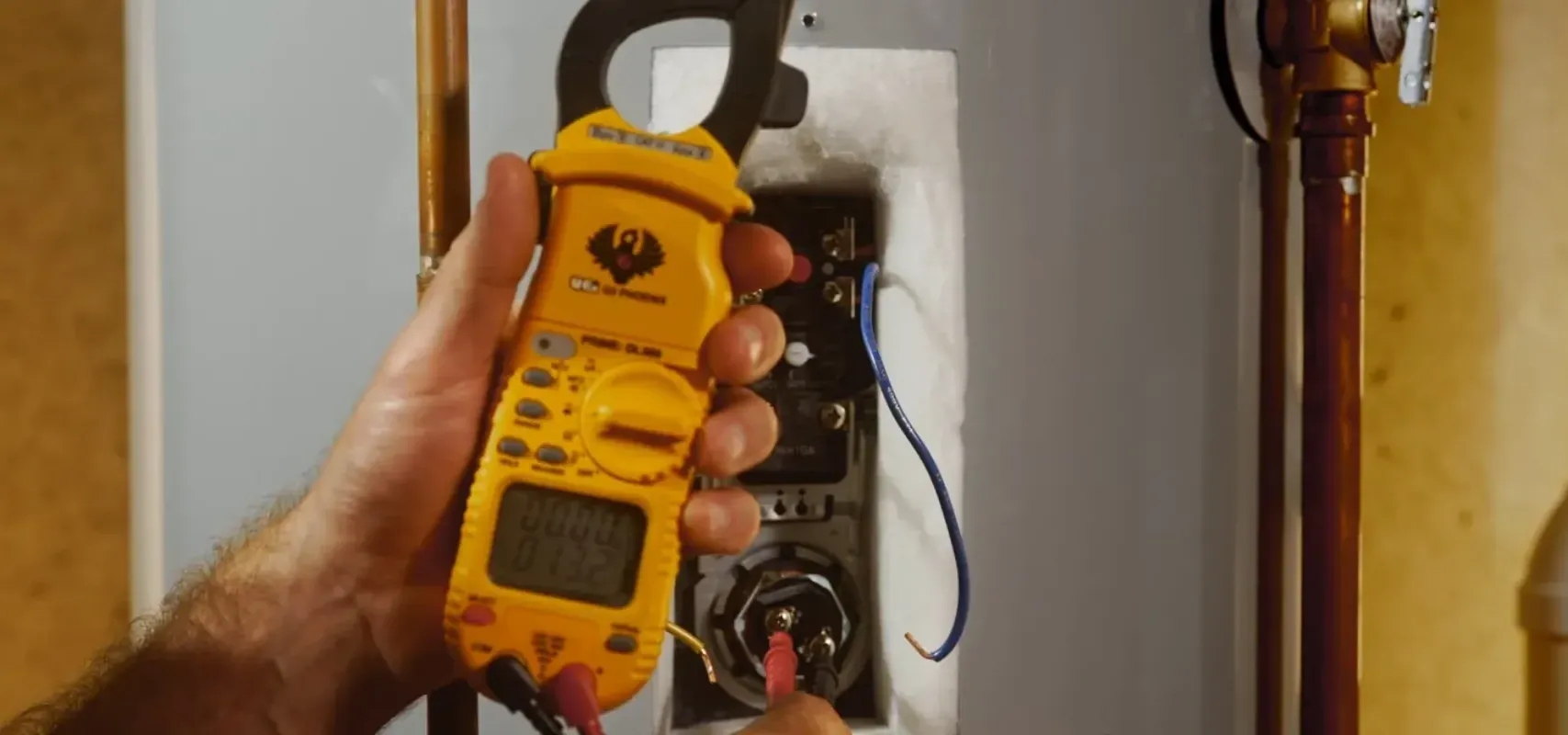
The tool is a multimeter. With the power off, we test each heating element for resistance, check the upper and lower thermostats and confirm the high-limit reset. A dead element reads open, and a grounded element reads continuity to the shell.
Elements are screw-in or bolt-in parts, and replacing one means draining part of the tank. If the tank is old, that drain often exposes thick sediment, which is useful to know before you spend money.
Parts that fail first, and parts that signal the end
Thermocouples, igniters, thermostats, elements and drain valves are low-cost wear items. When one fails on a tank that is otherwise sound, repair is the right call.
The anode rod is the sacrificial metal that corrodes so the tank does not. Manufacturers such as A. O. Smith advise checking it yearly and replacing it when the core wire shows over several inches. A tank that never had its rod checked may already have used it up, which is why an older heater can fail soon after an unrelated repair.
Leaks from the tank body, a collapsed liner of rust flakes in the drain water and a lower jacket that is wet all the way around are signs the vessel is finished. Putting a new part into that tank is paying twice.
The relief valve is not the problem to silence
Every tank has a temperature and pressure relief valve that opens when heat or pressure rises past safe limits. A valve that drips can point to thermal expansion in a closed system, a worn seat or real overheating, and each has a different fix.
We will never plug it, cap its discharge pipe or screw it down tighter. The correct fixes are an expansion tank, a replaced valve or a thermostat repair, all done under the Ohio Plumbing Code, which follows the 2021 International Plumbing Code as amended by Ohio.
Repair or replace: where we draw the line
Age is the first filter. Check the manufacture date coded in the serial number, which the maker's website or the technician can decode. A tank in its second decade with a new problem is often better replaced, especially if the anode rod was never serviced.
A repair makes sense when one part has failed, the tank is dry underneath and the shell is clean. Replacement makes sense when the tank leaks, when repair parts would cost most of what a new unit does, or when the heater is too small for the household. Our water heater replacement page covers what that swap involves.
Some homes are better served by a different type of heater altogether, and tankless water heater service is a separate topic with its own limits.
Cold incoming water and what it does to a tank
Lake Erie water reaches the heater through the Lake County Department of Utilities West Sub-District, and winter pulls its temperature down hard. The Cleveland area averages a January mean near 29 degrees Fahrenheit and about 64 inches of snow a year. Colder inlet water means longer burner runs, and long runs speed up sediment baking onto the tank floor.
Lake County's water report does not list a hardness figure, so we do not guess at yours. You can call the utility lab at 440-918-3420 or test your own tap, and that number tells us how fast scale will build in an electric tank's lower element. Where scale is heavy, a water softener or filter is worth pricing.
In Willowick, where the median home was built in 1957, heaters often sit in the same basement corner as the furnace. A leaking tank there can reach equipment that costs far more than the heater, so a slow drip is worth a call.
What drives the cost of a water heater repair
We do not quote repair prices in a web page, because the part, the access and the tank age change the answer. You will get a clear price before work starts, and the diagnostic scope is explained before anyone opens a panel.
The failed part
A thermocouple or thermostat is a small component, while a gas control valve or a pair of elements takes more time and a larger part.
Tank age and condition
Parts on a worn tank may fail again within months. We tell you when a repair is borrowed time.
Access and location
A heater in an open basement is quick to reach. One in a tight closet or crawlspace takes longer, and venting repairs can add work.
Draining and refilling
Replacing an element, a drain valve or a lower fitting means draining the tank. Heavy sediment adds flushing time.
After-hours dispatch
Night and weekend calls cost more to staff. We explain any dispatch difference when you call.
Insurance note. Homeowners insurance usually covers sudden water damage from a tank that bursts but not the heater itself or damage from slow, long-term leaks, so photograph everything and call for your number.
Safety standards on water heater repairs
Temperature and pressure relief valves are made to a listed standard, ANSI Z21.22, and the discharge pipe must follow the Ohio Plumbing Code, which is based on the International Plumbing Code (IPC). Gas models also fall under the National Fuel Gas Code, NFPA 54. A relief valve that drips should be inspected, never capped.
Water heater repair questions from Willoughby homeowners
Yes. The emergency line is answered 24/7, and a technician is dispatched to active leaks and no-heat situations. Tell us the fuel type, whether water is on the floor and whether you smell gas. If you smell gas, leave first and call the gas utility or 911, then call us. We do not promise arrival times, but we do book same-day appointments when available.
The usual causes are a worn thermocouple, a dirty pilot orifice, a draft pushing air past the flame or a failing gas control valve. A technician measures the thermocouple's output and checks the flue draft before replacing parts. Relighting it over and over is not a fix, and a flame that goes out can leave gas in the room.
Popping or rumbling means sediment is trapped under the burner or element and water is boiling through it. It is common on tanks that have not been flushed for years. A flush can quiet it and help recovery, but a tank thick with sediment may have lost life already, and the technician will tell you which case you have.
No. Capping or plugging the relief valve discharge defeats the safety device and can allow dangerous pressure to build. A drip points to thermal expansion, a worn valve seat or overheating. We find which one, then fix it with an expansion tank, a new valve or a thermostat repair as needed.
Look for water at the bottom of the jacket, rust-colored water from the hot tap only, and a tank old enough to need its anode rod replaced long ago. If the shell leaks, repair is off the table. We also look at how many parts have failed recently and what the remaining life of the tank looks like.
Yes. We serve Willoughby and nearby towns, including Wickliffe and Willowick. Permit rules differ by city and county, and where a repair needs one, we follow the local office's process. Call and tell us your address so we can confirm the area.