
Repiping in Willoughby, OH means replacing the water supply lines that run through your walls, floors, attic and basement, not the drains. The usual reason is old galvanized steel or a run of copper that keeps leaking at the same kind of spot. Done in one project, it ends the cycle of repair, stain and repair again.
This is planned work, so the pace here is calm. You can call (440) 468-0237 to talk through what you are seeing, and our 24/7 line is there if a pipe fails before the project starts. Most repipe conversations begin with a simple question: which parts of the house actually need to change?
Reading your pipes: material, symptoms, what it suggests
You can often tell what is behind the wall from the basement ceiling and from how the water behaves. Match what you see to the rows below, and use them as questions to bring to a plumber.
| Pipe type | What you may notice | What it often means |
|---|---|---|
| Galvanized steel (dull gray, threaded joints) | Brown water after the house sits, weak flow at the farthest tap | Rust buildup narrows the inside of the pipe, so pressure falls even when the water is on at the street |
| Copper with solder joints | Green or white crust at joints, pinholes along the side | Local corrosion, not always the whole run, so partial replacement can be enough |
| Copper in a house built before 1986 | Nothing visible, which is the point | EPA says lead solder and brass fittings can add lead even with no lead pipe, so test the tap water and ask about the joints |
| Gray plastic (polybutylene) | Leaks at fittings that arrive with little warning | Material known for failing at connections, so replacement is usually planned |
| CPVC or PEX (newer homes) | Few problems, sometimes a cracked elbow in CPVC | Usually a repair, a repipe only if a failure pattern appears |
A plumber confirms the material by looking at the pipe, not by guessing from the year the house was built.
Whole house, a floor, or one trunk line
Repiping does not have to mean every pipe in the building. A two-story house may have a good bathroom stack on the first floor and a failing galvanized trunk to the kitchen. We price the route that fixes the problem, then show you what each larger scope would add.
The decision rests on how many failures you have had, how rough the pipe looks inside when we cut it open, and whether more remodeling is coming. If you plan to open walls for a kitchen or bath project, that is the cheapest time to replace the supply lines in those walls.
Partial repipe
One floor, one bathroom group, or the run from the meter to the water heater. It makes sense when the problem is confined and the rest of the pipe is sound. Mixed materials get dielectric unions or proper transition fittings so steel and copper do not corrode each other.
Whole-house repipe
Every supply line from the shut-off valve to each fixture. This suits homes where galvanized steel remains throughout, or where leaks have hit several rooms in a few years. We route new lines through attics, crawl spaces and basements first, and open walls only where the route has no alternative.
Want a second opinion on your pipes?
Describe the leaks, stains and pressure you have noticed, and we will tell you if a repipe is warranted.
PEX or copper: how we help you choose
Both are widely used for home supply lines. The better pick depends on the house and your priorities.
PEX tubing
Flexible, so it snakes through finished walls with fewer cuts and joints. It copes with a freeze expanding inside better than rigid pipe, though fittings still need protection from cold. It must stay out of direct sunlight and away from flame.
Copper pipe
Rigid, fire resistant and familiar. It takes more joints, more labor and more care around corrosive water chemistry. Lake County does not publish a hardness figure, so ask the utility lab at 440-918-3420 if water chemistry concerns you.
Manifold layouts
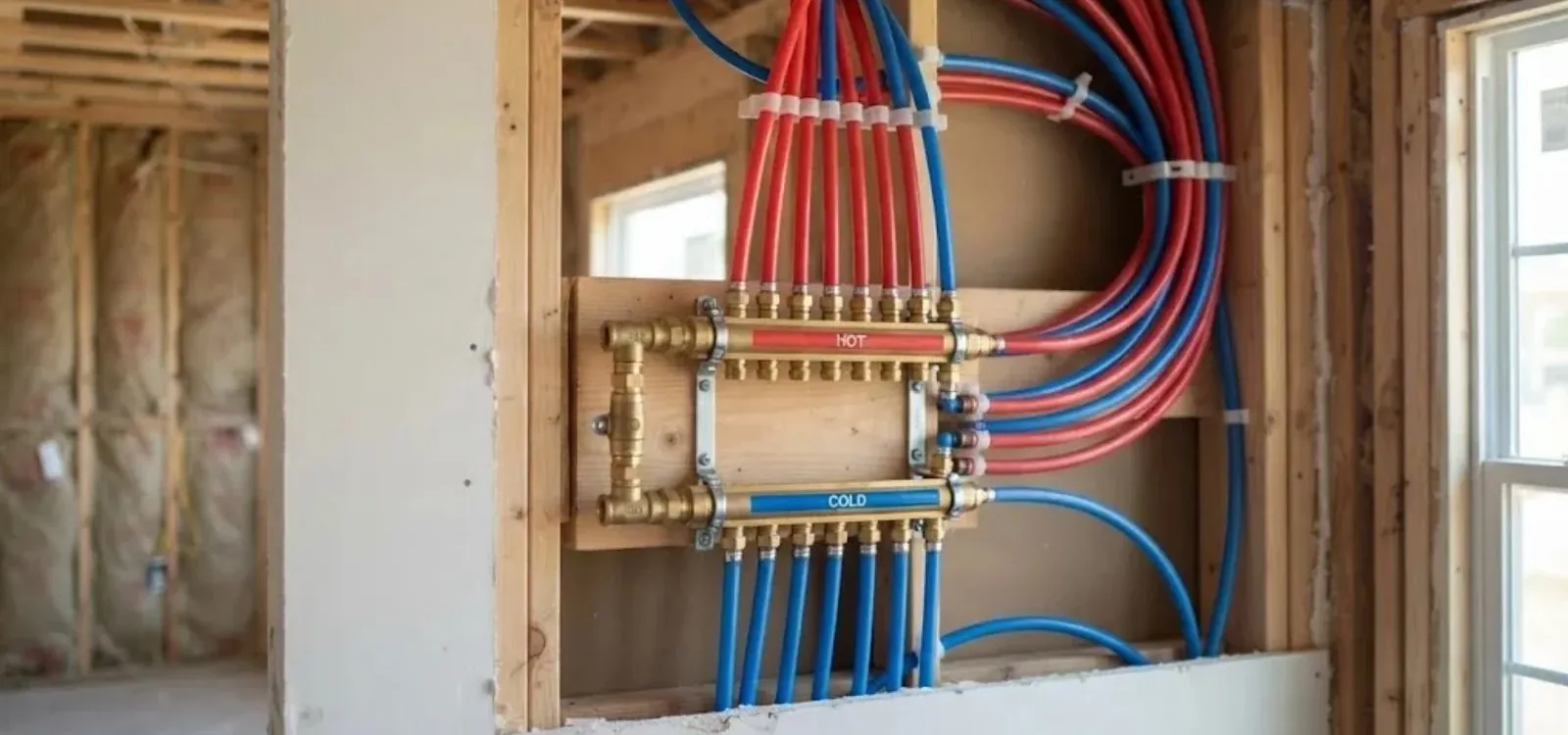
A manifold sends a dedicated line to each fixture from a central point. It shortens the wait for hot water at a distant tap and lets you shut off one bathroom without losing the house.
Insulation and routing
On exterior walls, pipes are run to the warm side of insulation where possible. In this climate, a pipe in an outside wall is the first to freeze in a cold stretch.
How a repipe project runs
The sequence below is typical. The scope of your house decides the details.
- 1
Walk-through and route plan
We look at the basement, attic and crawl space, trace the existing supply, and note the water heater, softener, meter and every fixture. We also check water pressure with a gauge at a hose bib.
- 2
Permit and scheduling
We pull the plumbing permit from the correct authority, and you agree the days and the rooms where water will be off. Larger houses are usually phased so the family can keep a working bathroom.
- 3
Rough-in of the new lines
New pipe is run alongside the old, with access holes cut in drywall at strategic points. We protect floors and furniture, and we fire-stop and support pipe as required.
- 4
Connect, flush and pressure test
Fixtures are connected one group at a time, the system is flushed, and we pressure test before anything is closed. Inspection follows according to the issuing authority's rules.
- 5
Cut out the old and hand over
Abandoned pipe is removed where it is accessible. Drywall patching and painting are separate trades unless otherwise agreed, so ask us for a list of what to expect.
Getting the house ready
A few preparations make the work calmer for everyone.
Clear access
Empty the cabinets under sinks, clear the basement ceiling area and make a path to the attic hatch and crawl space.
Plan for water-off time
Store drinking water and plan for toilets and showers. We tell you before each shutoff, and we add isolation valves so one area can be closed without losing the whole house.
Protect valuables on walls
Take pictures and mirrors down from walls we expect to open. Dust control is part of the work, but fine dust travels.
Share your history
Tell us where leaks occurred, when, and what repairs were done. The pattern shows which parts of the run deserve closest attention.
The service line, lead and what a repipe does not cover
A repipe replaces pipe inside the house. The buried line from the street to the meter and into the building is a different job, covered by our water service line replacement. If your home might have a lead service line, Lake County Utilities publishes an address-search inventory map at lead-service-line-inventory-lcdugis.hub.arcgis.com.
The utility's 2025 report shows lead below 2.0 ppb at the 90th percentile and none of the 30 sampled homes over the 15 ppb action level. That describes the system sample. It does not reveal what material sits under your own yard, so check your address before you decide the order of work.
Housing age in the towns we serve
Census data puts the median year built at 1957 in Willowick and Wickliffe, 1967 in Eastlake, and 1973 in Mentor and Willoughby Hills. In Willowick, 54.1 percent of homes were built in the 1950s, a time when galvanized steel supply was common. If your house is in that age band, the pipe in the wall deserves a look before a leak makes the decision for you.
Homes in Mentor and Willoughby Hills skew newer, so a repipe there is more often triggered by a specific failing material than by age alone. Downtown Willoughby has older buildings in its historic district, where the supply and drain lines are likely older still, so a visual check of the actual pipe beats assumptions about material.
Source: U.S. Census American Community Survey housing data (2016 estimates) and the National Register historic district listing, City of Willoughby
What a repipe costs and what moves it
A repipe is a project, so there is no honest flat figure. We give you a clear price before work starts, laid out by scope, so you can compare a partial against a whole house.
Number of fixtures
Every bath, kitchen, laundry, hose bib and appliance line adds pipe and connections.
Square footage and floors
A ranch with a basement is a straight run. A two-story house with finished ceilings and tight chases takes more routing time.
Access
Open basement joists and a walk-in attic keep wall openings small. Finished spaces, plaster walls and slab-on-grade rooms add labor.
Pipe material and layout
PEX with a manifold, trunk-and-branch PEX and copper each differ in parts and labor.
Permits and finish work
Permit fees follow the issuing authority's current schedule. Drywall and paint are separate trades, so decide who does what up front.
Insurance note. Homeowners insurance usually treats repiping as maintenance and does not cover it, though it may pay for sudden water damage from a pipe failure, so ask your insurer and call us for your number.
Repiping questions
One leak in sound pipe is a repair. Several leaks within a few years, brown water, falling pressure at far taps, or pipe that crumbles when cut point to a repipe. We can look at the basement and attic, cut a test section, and tell you which side your house falls on.
We open as little as the route allows. New lines go through attics, basements and crawl spaces whenever possible, and walls are opened at specific access points. Drywall repair and paint are separate unless we agree otherwise, so ask for a plan that shows each opening.
That depends on the size of the house and the scope. We schedule the work in stages and tell you before each shutoff. Where the plan allows, we keep one bathroom usable between stages. Call (440) 468-0237 and describe your layout so we can speak to your house.
Yes. Plumbing permits come from the City of Willoughby Division of Building Inspection for homes inside the city, and from Lake County Building Department for many other communities, including Willoughby Hills and Willowick. We pull the permit and schedule inspections. Ask your building department about current fees.
Yes, but the first step is stopping the water. Shut off the main and call our 24/7 line at (440) 468-0237. We stabilize the failure, often with a repair, and then plan the larger work when the pressure is off. Our leak detection service helps you see how widespread the problem is.
Buyers and inspectors flag galvanized or polybutylene pipe, and it can slow a sale. A clean permit record and a pressure test report give them something concrete. We cannot tell you what a repipe does to your home's value, so ask a local real estate agent.