
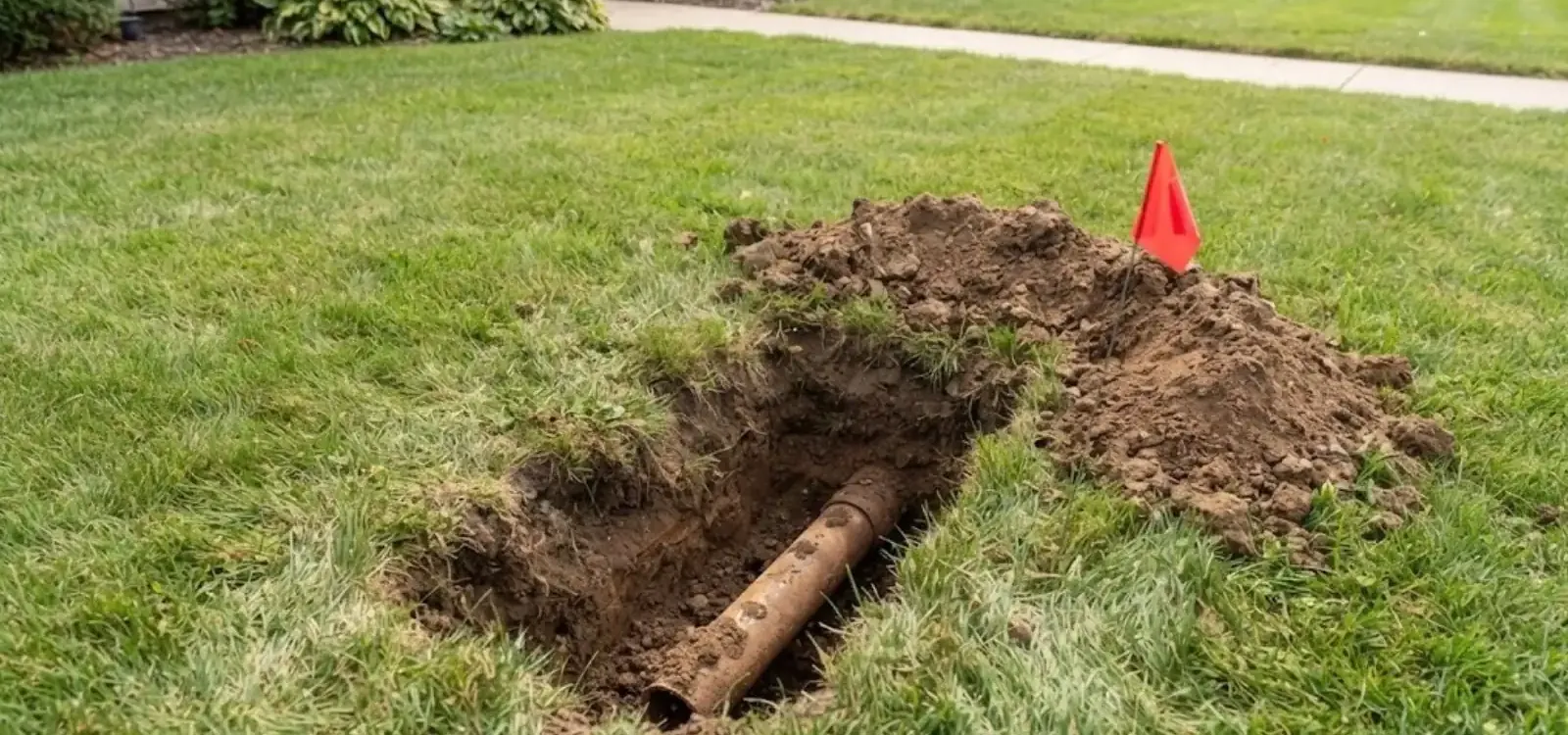
Sewage in a floor drain or a shower cannot wait, and our line at (440) 468-0237 is open 24/7. Stop running water, keep children and pets out of the wet area, and leave the drain alone until someone has looked at it. Sewer line repair in Willoughby, OH means fixing the buried pipe, called the lateral, that carries waste from your house out to the city main.
Most backups are clogs that a cable or a jet clears in one visit. A line that backs up again within weeks, or that a cable cannot get through, usually has a physical defect: a root-split joint, a sag that holds water, a crack, or a collapsed section. This page covers those repairs and how to choose between them.
What actually breaks a buried sewer line
Roots are the most common story. They enter at joints, where pipe sections meet, and grow into a mat of fine hair that catches paper and grease. Cutting or jetting clears them, but if the joint stays open the roots come back, which is why a line that clogs every year or two deserves a camera rather than another cable.
A belly is a low spot where the pipe has settled. Water pools in it, solids drop out of the flow, and the line clogs even with no roots at all. Bellies come from poorly compacted backfill, washed-out soil, or a pipe that was never laid at a steady slope. A cable will not cure one, and neither will a liner.
Older houses add material problems. Clay tile cracks and slips apart at joints, and the bituminous fiber pipe often called Orangeburg, common in mid-century construction, flattens and flakes with age. Newer PVC fails less often, but a joint can still separate when soil moves. Ask the camera operator to name the pipe material on the video, because it decides which repairs are even possible.
Sewage coming up in the house: what to do first
Treat anything that rises through a drain as contaminated. Stop using sinks, showers, toilets, the dishwasher and the washing machine, because every gallon you send down has nowhere to go except out of the lowest drain in the house. If the basement floor drain is the one backing up, the blockage is usually downstream of your house.
Do not pour chemical drain opener into a backed-up line. It rarely reaches the blockage, it sits in the water, and it can burn skin or splash on the next person who opens the pipe. Do not push a rented cable into a line you suspect is collapsed either, since a cable can snag on broken clay and make the repair harder.
Want the pipe seen before you decide?
Call and describe your symptoms, and we will talk through whether a camera run, a cleaning or a repair makes sense.
Before the technician arrives
These steps limit damage and give the technician useful information.
Hold all water use
Ask everyone to skip flushing and laundry. A single wash load sends dozens of gallons toward a line that is already full.
Clear the floor
Keep children, pets and bare feet out of any wet area. Lift cardboard, rugs and stored items off the floor, and wear rubber boots and gloves if you must walk through.
Locate the cleanout
A cleanout is a capped pipe near the basement floor or outside the house. Note where it is, but leave the cap on while the line is full, because sewage can pour out when it opens.
Ask the neighbors
If several houses on the street are backing up, the problem may be the city main. In that case call City Hall at 440-951-2800 so the sewer division hears about it.
Photograph the damage
Take pictures of the water line on the walls, affected belongings and the drain itself before any cleanup. Your insurer will ask what came up and when.
Stay out of water near power
If water is reaching outlets, the furnace or the electrical panel, do not step into it. Call an electrician or your electric utility first.
Spot repair, lining, bursting or open-cut: what fits which defect
The camera finding decides the method. This table shows how the common findings usually map to repairs, and where each method runs out of road.
| Defect on camera | Methods that can work | Honest limit |
|---|---|---|
| Root-split joint, pipe otherwise sound | Cut the roots, then a spot repair or a liner over the joint | Roots return if the joint is left open |
| Belly or sag holding water | Open-cut to relay the pipe at a steady slope | Needs a trench, and a liner would keep the low spot |
| Long crack or many bad joints, pipe still in line | Cured-in-place lining or pipe bursting | The pipe must be cleaned first, and branch connections are reopened from inside |
| Collapsed or offset section | Open-cut at the failure, or bursting where the path is clear | A liner cannot pass a collapse or a stepped offset |
| Orangeburg or heavily flaking pipe | Replacement by bursting or open-cut | Lining soft, deteriorated pipe is a poor bet, so the video decides |
We tell you plainly which of these methods we perform and which would go to a lining or excavation specialist.
Trenchless versus open-cut, said plainly
Neither method is better in general. Each wins on certain pipes, and a contractor who only sells one will push you toward it. Ask every bidder what equipment they own, and expect an honest answer from us about where our work stops.
Where trenchless wins
Trenchless repair works through small access pits or an existing cleanout instead of a long trench. It pays off when the pipe runs under a driveway, a patio, a mature tree or a finished basement slab, because you avoid tearing those out. Lining builds a new pipe wall inside the old one, and bursting pulls a new pipe through as the old one is broken apart.
Where open-cut is the honest answer
Digging is the better call when the pipe has collapsed, when it has a belly that must be regraded, or when the run is short and the yard is open. You also see exactly what you are repairing, and the new pipe is bedded and sloped on purpose. The trade-off is restoration of sod, landscaping, concrete or asphalt, and sometimes a street opening.
What neither one fixes
Neither method cures a downspout wrongly tied into the sanitary line, and neither helps if the blockage sits in the city main. Both begin with a cleaned, camera-checked pipe, and both should end with a second camera pass so you see the finished pipe on video before the trench is closed or the access pit is filled.
Before anyone digs: Ohio 811 and the city sewer permit
Ohio law requires excavators to notify OHIO811 at least 2 working days before digging, and no more than 16 calendar days ahead. You reach them by calling 811 or 800-362-2764. Utilities then mark their buried lines, so a planned dig needs that notice first, even when the camera work finishes early.
A homeowner digging their own yard is generally outside the statute unless the dig is in an easement, right of way or area served by utilities, but a call before any deep digging is still sensible.
Inside the City of Willoughby, plumbing permits come from the city's Division of Building Inspection, and the city also issues separate sewer permits for storm and sanitary line work. Digging in the street or other city right of way brings its own right of way permit. Ask whoever quotes your job who pulls each permit, and whether the contractor is registered with the city.
The permit office changes just outside the city line. Plumbing permits in Willowick and Willoughby Hills come from the Lake County Building Department in Painesville, as covered on our Willoughby Hills service page, while Eastlake runs its own building department. We confirm the right office before a job is scheduled, since a missed permit can stall a finished repair.
Not every backup is your pipe
The city's 2020 sewer overflow report logged two basement backup reports in Willoughby, and both were coded as debris in the line, one of them involving a surcharged city manhole. Before paying for a dig, have a camera run through your lateral and ask the neighbors whether they back up too.
A clean, intact lateral points the problem toward the main. The city maintains its own collection system through its Division of Storm and Sanitary Sewer Repair and Maintenance, and that is a call you can make with the video in hand.
When backups follow the rain
A line that only backs up during heavy rain is taking in water it was not built for. Cracked joints let groundwater seep in, and illegal connections push roof or foundation water into the sanitary line. Willoughby Sec. 915.04 bars roof downspouts, sump pumps, foundation drains and areaway drains from connecting to a building sewer tied to the public sanitary sewer.
The regional picture explains why this matters. After the April 1, 2026 Chagrin River rise, Willoughby Hills reported flooded basements and some raw sewage backups. That was a different city, but the same wet ground and heavy storm flows affect sewers all along the river.
If your backups track rainfall, ask for a camera run during or right after a storm and a trace of where every downspout and sump discharge goes. A sump pump plumbed into the sanitary line tied into the sanitary line is a fixable cause, and finding it first can save a dig.
Clearing first, repairing second
Plenty of calls end with a cleaning and no repair. A sewer line cleaning with a sectional machine cuts roots and opens a blocked line so the camera can travel its full length. A hydro jet scrubs grease and scale from a sound pipe, but it will not close a crack or lift a sag.
The right order is clear the line, run the camera, then decide. If the video shows a clean pipe with a few roots, a cleaning schedule may be all you need. If it shows broken clay, you have a repair on your hands, and the video is the evidence for any quote you collect. A standalone camera inspection is also how buyers check a lateral before closing.
What drives the cost of a sewer line repair
Sewer work has the widest price spread of any plumbing job, which is why no honest number can be given without a camera finding. Two neighboring houses can need very different work. These are the drivers we price from.
Length and depth
Laterals are laid below the frost line, about 40 inches in Lake County Building Department's design table. A deeper, longer run means more digging or longer liner.
Method
Spot repair, lining, bursting and open-cut each carry different labor and equipment, and the defect often allows only one or two.
Surface restoration
Lawn is cheap to replace. Driveways, patios, sidewalks and a street opening are not, and restoration is often a separate trade.
Access and obstacles
Trees, other utilities, foundations and tight side yards slow open-cut work and can push the job toward trenchless.
Permits and inspection
Sewer and plumbing permits, a right of way permit where it applies, and the inspection visit all add time.
Insurance note. Homeowners insurance usually covers sudden, accidental damage inside the house, but often excludes gradual root growth and wear in the pipe itself, and some policies sell a separate sewer backup endorsement, so call for your number and read your policy.
Permits and code for sewer line work
A building sewer repair or replacement must meet the Ohio Plumbing Code, which is based on the International Plumbing Code (IPC), including bedding, slope and approved pipe, and most replacements are inspected before the trench is closed. Call 811 before any dig so buried utilities are marked, which is a free call.
Sewer line repair questions we hear
Yes. The line at (440) 468-0237 is staffed 24/7, including weekends and holidays. Tell us what is happening, and we will explain the next step and whether the first visit is clearing the line or a camera run. The permanent repair is usually planned after the line is open, because digging needs an 811 notice and a plan.
One slow fixture is usually a local clog. When several fixtures gurgle or back up together, or the lowest drain overflows when upstairs fixtures run, the main line is the likely culprit. A camera settles it, and a drain cleaning visit can often rule out the fixture drain first.
Sometimes. Lining works when the pipe is cleaned, still roughly in line, and not collapsed or stepped at a joint. It does not remove a belly, and it is a poor fit for soft, flaking pipe. The camera video tells us which side of that line your pipe falls on, and we will say so honestly.
Open-cut digs a trench along the failed section only, not the full run, when the camera locates the defect. A locator on the camera head marks the spot above ground. Trenchless repair uses small pits instead. Restoring sod is normally part of the quote, while driveway or concrete restoration may need another contractor, so confirm that in writing.
No. The city maintains its own collection system, and the sewer main in the street is outside a homeowner's repair job. We work on your lateral from the house to the connection. If the camera shows a clean lateral and the problem is the main, we give you the video to take to City Hall.
It adds a step, not a long delay. Inside Willoughby the city issues the plumbing and sewer permits, and a right of way permit applies if the work reaches the street. Outside the city, Lake County Building Department handles some communities, such as Willowick and Willoughby Hills. We sort out the right office before scheduling.
Not directly. Septic systems have a tank and a drain field, and their repairs fall under the health district. If your home has a septic tank, a sewer-line page does not apply, so ask the Lake County General Health District at 440-350-2543. We can still help with the plumbing inside the house.