
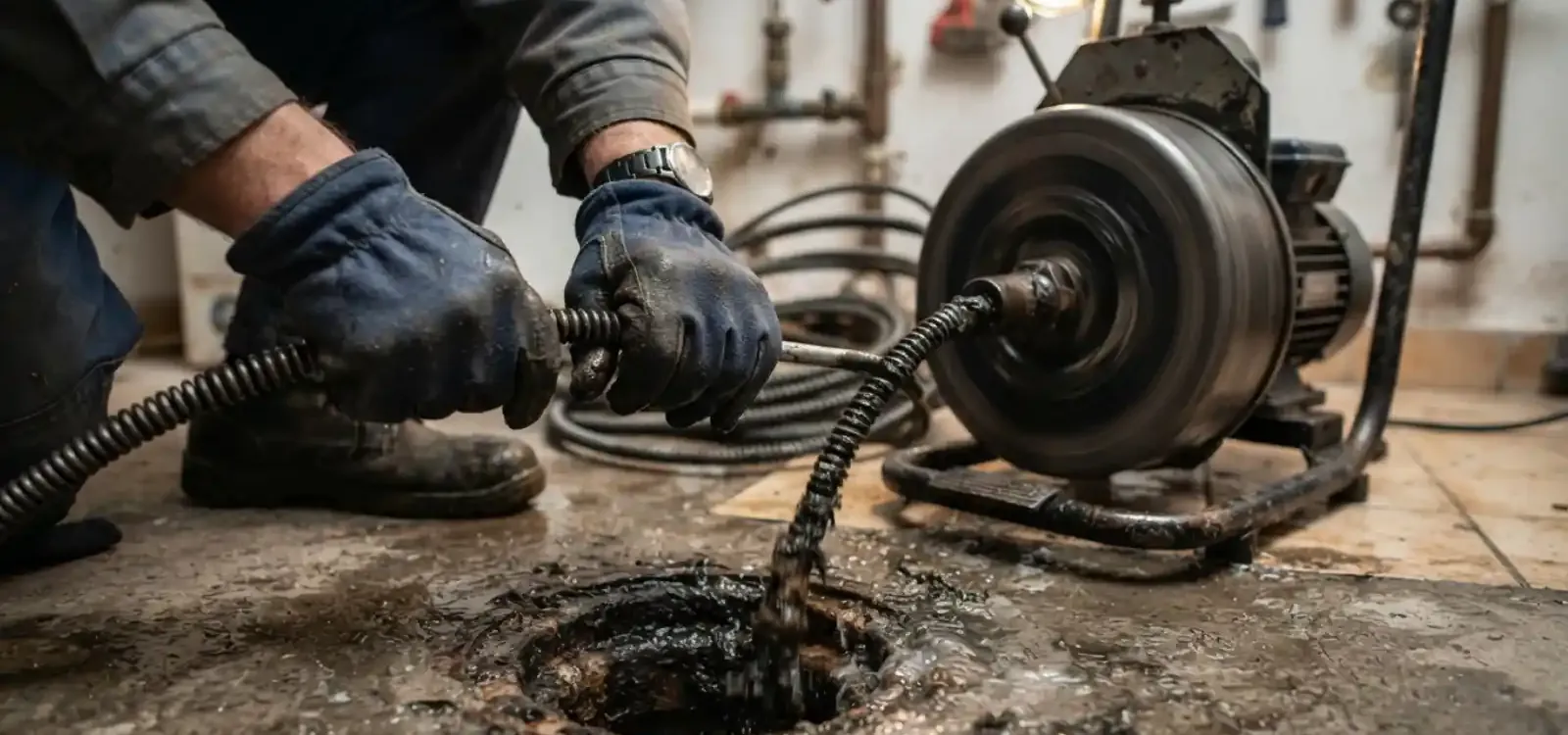
Sewage in a basement shower or floor drain means the main line out of your house is blocked. Our 24/7 emergency line takes sewer line cleaning calls in Willoughby, OH. Stop using every drain, keep people away from the wet area and leave the toilets alone until we have cleared the line.
Sewer line cleaning clears the pipe that carries all of your house's wastewater to the city main. It is bigger than a sink clog. The machine is larger, the cable is longer, and the work starts at the cleanout instead of under a vanity.
Sewage backing up: what to do first
Stop all water use at once. That means the washer, dishwasher, showers and every toilet. Each flush or drain sends more wastewater toward the lowest opening in the house, and that opening is probably a basement drain.
Keep children, pets and bare feet out of the area. Sewage water carries bacteria, so wear rubber boots and gloves if you must cross it. If water is near the furnace, water heater or electrical panel, stay clear and call. Do not pour bleach or drain opener into a backed-up line.
Then call us at (440) 468-0237. Tell us how many drains are involved, whether the cleanout is open, and if water rose during rain or a power loss. Those answers change what we bring.
Set up the work area before we arrive
Find and uncover the cleanout
Look for a capped pipe, usually about four inches wide, near the basement wall where the sewer leaves the house or in the yard near the foundation. Move anything blocking it, but do not open the cap. A backed-up line can push sewage out at you.
Lift valuables off the floor
Pull boxes, rugs and electronics up onto shelves or tables. Porous items soaked by sewage are usually discarded, so move what you can before more water arrives.
Photograph everything
Take pictures of the water line, the affected rooms and the damaged items. Insurance adjusters ask for them, and it is easier to take them now than after cleanup.
Note any recent changes
Tell us about tree work, a new disposal, a recent heavy rain, a power outage or sewer work on your street. Each one points to a different cause.
Sewage on the floor right now?
Call (440) 468-0237 and tell us which drains are involved. We will say what to shut off and what happens next.
Clues the blockage is in the main, not a fixture
Two or more drains fail together
A tub and a floor drain backing up at once do not share a branch line. They share the main.
The toilet bubbles when the washer drains
Air displaced by water is being forced back up through the nearest trap. The line is partly closed ahead of that point.
The lowest drain fills first
Wastewater seeks the lowest outlet in the house. A basement shower or floor drain shows a main problem before an upstairs bath does.
Everything is slow after a heavy rain
Storm water entering a cracked or loose lateral slows the whole line. This is not always a blockage, and a camera sorts it out.
The yard smells of sewage
Odor or wet ground near the lateral can mean the line is leaking out or backing up at a break, which needs a camera and may need repair.
How we clear the main line
- 1
Open the cleanout and read the line
We loosen the cap carefully, with a bucket and protection ready. How the water behaves tells us whether the blockage is close or far.
- 2
Run a sectional machine toward the street
A sectional machine drives a stiff cable through the line. Different cutter heads grab debris, scrape grease or slice roots, and we change them as we feel the cable work.
- 3
Flush and test
Once the line opens, water runs freely, and we run the fixtures upstairs to confirm the whole house drains at once.
- 4
Push a camera through when the cause is unclear
A push camera with a locator shows whether the blockage came from roots, a sag, a broken joint or something your household flushed.
- 5
Explain what we found
You hear what was in the line, what is likely to return, and whether you need jetting, a repair or nothing further.
What each backup symptom suggests about the main
| What you see | What it usually means | Next step |
|---|---|---|
| Basement floor drain bubbles when upstairs fixtures run | Partial blockage in the main | Cable from the cleanout, then flow test |
| Toilets will not flush and a shower fills | Complete blockage | Emergency clearing, camera after |
| Backup begins during a storm and clears afterward | Storm water loading the line | Camera and a look at downspout and drain connections |
| Same backup returns every few months | Roots, grease or a sag | Jetting or repair after camera |
| Backup after power loss | Sump or ejector pump out | Different problem: pump check, not main clearing |
A backed-up main is not the only source of water in basement drains, so we sort out which one you have before any machine goes in.
Why the basement floor drain is always first to warn you
Gravity moves all the wastewater in your house toward the sewer. When the sewer is blocked, the lowest point in the plumbing gives way first. In most Lake County houses that is the basement floor drain, a basement bathroom or a laundry tub.
Do not be reassured because the upstairs works. The upstairs fixtures sit higher than the water level in the backed-up line. They may drain slowly for hours and then fail all at once when someone takes a shower.
If the floor drain is the only place you see water, the toilets still flush and the sinks are normal, ask us about the drain itself. That can be a separate clog, a dry trap or a leak, and a main line machine may not be needed.
Debris, storms and the Chagrin watershed
Willoughby's 2020 sewer overflow report listed two basement backups, both traced to debris in the line. Neither was a failed city main. That is a reminder to clear and camera your own lateral first, before anyone talks about digging.
Storms are another source. In April 2026 the Chagrin River rose above 14 feet, and basements flooded in Willoughby Hills, with power outages disabling sump pumps and some sewage backups. A backup in that setting may not be a clog at all. If it started with rain or a power cut, tell us so we can check the pump and discharge before we blame the main.
Willoughby City Code Section 915.04 prohibits connecting downspouts, sump pumps, foundation drains or areaway drains to a building sewer tied to the public sanitary sewer. That water belongs in storm sewers or an approved outlet. If yours is tied in, cleaning the main is only a temporary cure.
Septic tanks and what we do not do
If your home has a septic tank, a sewer-line page does not apply. The Lake County health district estimates about 15,000 households countywide use septic systems, so check before you call. The Lake County General Health District at 440-350-2543 can tell you what serves your address.
We clear the line and check it. We do not clean up sewage-soaked flooring or drywall. That is a restoration contractor's job, and your insurer may ask for it. We also do not dig up yards. If the camera shows a broken pipe, we explain the repair path and you decide.
Preventing the next backup
Once the line is open, the question is what caused it. Wipes, paper towels and grease belong in the trash. Tree roots call for a camera, since cutting them only buys time. A line that has been cleared and clogs again within a year deserves hydro jetting to scour the wall, or a camera inspection to find the defect.
A backwater valve closes when sewage tries to flow backward into a house. A plumber installs it on the lateral under the local permit rules. The City of Mentor has run a sewer-backup grant that lists backwater check valves as eligible, but its page dates to 2016, so ask the city whether funding is open. Mentor homeowners can start with plumbing service in Mentor, and our plumbing installation work covers the valve.
If the camera finds a cracked or collapsed section, cleaning will not hold. That is where sewer line repair begins.
Who owns the pipe, and who to call
In Willoughby, the city handles sewer collection through its Division of Storm and Sanitary Sewer Repair and Maintenance, and wastewater goes to the Willoughby-Eastlake Water Pollution Control Center on Erie Road. Your private lateral runs from your house toward the city main. Where exactly the private part ends on your street is a question for the city, reachable through City Hall at 440-951-2800.
We clear your lateral from your cleanout. If the camera shows the blockage is out in the street, we tell you and you can report it to the city with something concrete to say. Neighbors in Chagrin-side Eastlake face their own flooding questions, and our Eastlake plumbing page covers them.
What sets the cost of sewer line cleaning
A backed-up main is not priced like a sink clog. The machine, the cable length and the time on site all go up. You hear a clear price before work starts, after we see the cleanout and the line.
Distance to the blockage
A clog close to the house is a short run. One near the street takes full cable length and more time.
What the blockage is
Wipes and paper clear quickly. Roots and grease packed over months take repeated passes and different heads.
A usable cleanout
A cleanout makes it a clean job. Without one, we may need to pull a toilet or find another access point.
Camera after clearing
A camera pass adds time and shows what caused the backup and whether it will return.
Hour of the call
A night emergency and a scheduled daytime visit are set up differently. Tell us which you need.
Insurance note. Homeowners insurance usually does not pay to clear a clog, but sewage damage to the house may be covered if you carry a sewer or water backup endorsement, so ask your agent and call for your number.
Code basics for a cleaned sewer line
The Ohio Plumbing Code, which is based on the International Plumbing Code (IPC), requires cleanouts at set points on a building sewer. Cleaning through a cleanout is cleaner and safer than pulling a toilet, and it leaves the wax seal alone. If sewage is in the house, keep people and pets out of the wet area.
Sewer line cleaning questions from Willoughby homes
Yes. Our 24/7 emergency line at (440) 468-0237 takes sewer backups at any hour. Tell us which drains are involved and whether anything electrical is near the water. We will say what to do next and what is open. Until then, stop using all water.
Most homes have a capped pipe about four inches wide. Check the basement near where the sewer leaves the house, or look outside along the foundation. If you cannot find one, say so on the call. We will work from another access point such as a toilet flange or a vent.
No. A backed-up line is under head pressure and can send sewage out as soon as the cap loosens. Uncover it and leave it closed. We bring the bucket, protective gear and tools to open it in a controlled way once the technician is ready.
Usually yes, if the cause is unclear or the backup is a repeat. A push camera with a locator shows roots, sags and cracks, and marks where on the lawn they sit. If the cause was obviously a wad of wipes, we may skip it.
Your lateral runs from the house toward the city main. If the clog is on your side, we clear it. If the camera shows the problem is in the street, you report it to the city through City Hall at 440-951-2800, and you have the footage to back it up.
Tell us. Storm water entering a cracked lateral or a power cut that stopped a sump pump can look exactly like a clog. We check the pump, its discharge and the line before we blame a blockage. Cleaning alone will not solve a stormwater connection, and we will say so.
We offer same-day appointments when available, and an active backup goes through the 24/7 line. Call us at (440) 468-0237 and describe what is happening, including which drains are involved and whether the cleanout is clear. We will tell you what can be done today.