
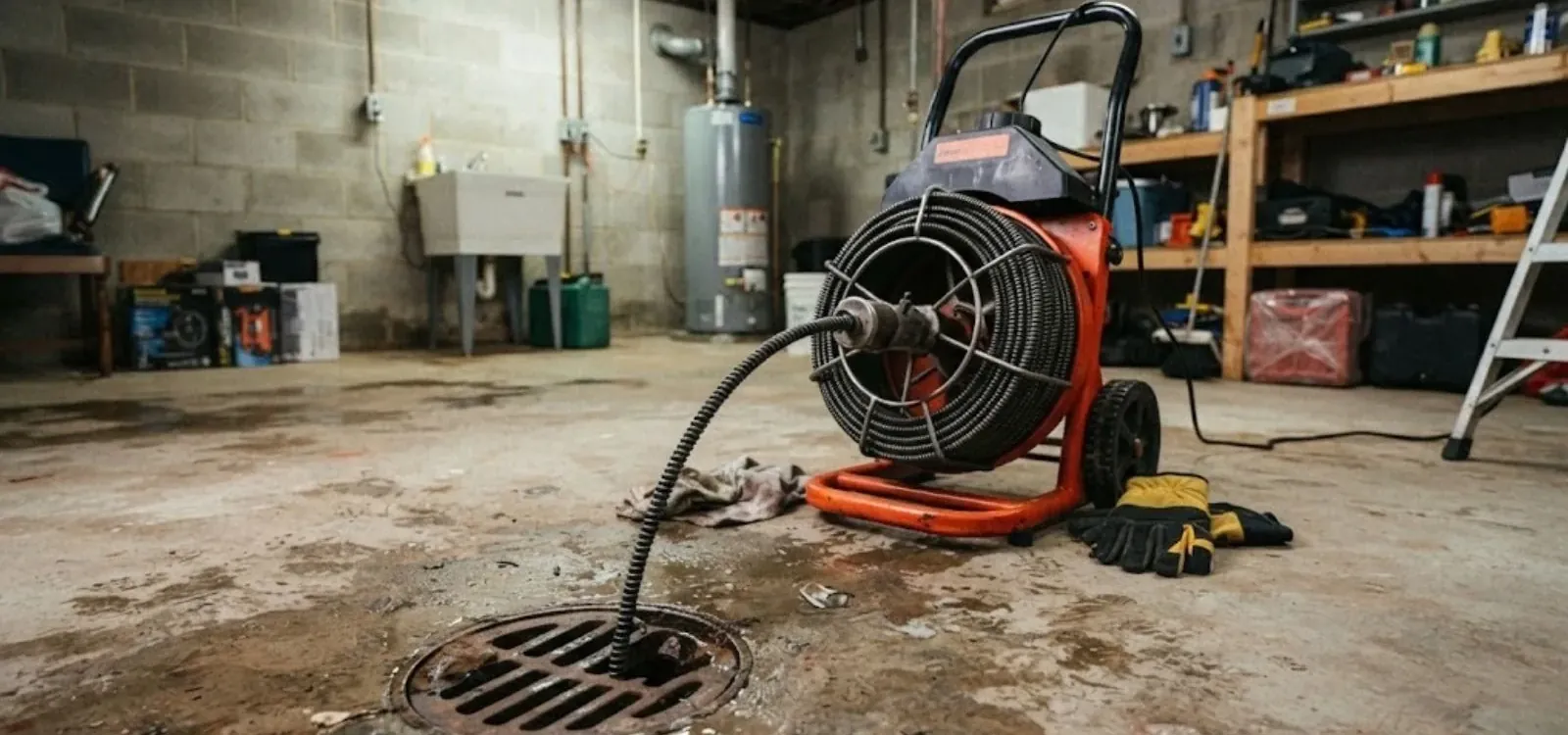
A drain that has stopped moving water becomes a house problem by tonight, not next week. Our 24/7 emergency line takes drain cleaning calls in Willoughby, OH. While you wait, stop running water, leave the toilets unflushed if a floor drain is bubbling, and keep children and pets off any wet floor.
Drain cleaning means removing whatever narrows or plugs a drain pipe, then proving the water runs freely afterward. For one sink, that is usually a cable through the trap and branch line. For a whole-house backup, it is a larger machine run from the cleanout. The first job on every call is working out which of the two you have.
Sort your clog: one fixture or the whole house
Five minutes of watching your drains saves a wasted visit and tells us what to load on the truck.
One fixture slow, the rest fine
The blockage sits in that fixture's trap or short branch. Hair in a tub, grease in a kitchen sink and lint in a laundry standpipe are the usual suspects, and a small cable clears them.
Two fixtures on one floor act up together
They share a branch line. A tub that gurgles when the bathroom sink drains is the classic sign, and the clog is past the point where the two lines join.
The lowest drain gurgles or rises when you flush upstairs
The main line is restricted. Water shows up at the lowest opening first, which in most Lake County houses is the basement floor drain or a basement shower.
Slow, then fine, then slow again
A partial blockage that shifts. Roots, grease or scale narrow the pipe, and each cleaning only opens a hole through the middle.
Sewer smell near a floor drain
Sometimes the trap has simply dried out. If the smell comes with standing water or slow drainage, something is holding sewage back in the line.
When a clogged drain is an emergency
Treat it as an emergency when wastewater is coming up into the house, when every toilet will not flush, or when water is spreading toward an electrical panel, furnace or finished basement. Those backups get worse every time anyone runs a tap, a shower or the washer.
A single slow sink or tub is different. It is irritating, not dangerous, and a same-day appointment when available is usually enough. If you are unsure which one you have, call and describe what you see. We would rather talk it through than have you guess.
Water standing in a drain right now?
Call (440) 468-0237 and tell us which fixtures are slow. That alone tells us what machine to bring.
While you wait for the technician
Four things help and none of them need tools.
Stop adding water
No dishwasher, no laundry, no showers. Every gallon you send down has nowhere to go and ends up on the floor.
Skip the chemical opener
Lye and acid products sit in a pipe that is not draining. They can burn skin when the trap is opened and they do not cut through hair or roots.
Keep clear of wet electrics
If water is near the panel, outlets or a plugged-in appliance, stay out of that area and shut off power only if you can reach the panel from dry ground.
Find the cleanout
It is a capped fitting on the main line, often near the basement wall where the sewer leaves the house or just outside. Clear the area around it so we can start right away.
How a drain gets cleared from first look to final flush
- 1
Locate where the water stops
We run water at each fixture and watch where it slows, gurgles or backs up. That draws a map of the blockage before any tool goes in.
- 2
Use the closest access point
Pulling a sink trap or working from a cleanout is cleaner and safer for the fixture than forcing a cable through a toilet or a tub overflow.
- 3
Match the cable to the pipe
A small drum machine handles sink and tub lines. A sectional machine with a stiffer, longer cable reaches the main. The head on the end changes with the job: a spear to grab, a blade to cut roots and grease.
- 4
Retrieve and clear
We bring back what we can, such as hair, wipes or a wad of grease, so you can see what caused it. Pulling it out beats pushing it downstream to lodge again.
- 5
Prove it with full flow
We run every fixture on that line at once, flush the toilets and watch the lowest drain. A clog that only looked cleared will show itself right then.
Where the water backs up and what usually causes it
Read this before you call and you will describe the problem in terms we can act on.
| Where it shows | Usual cause | How it is cleared |
|---|---|---|
| Kitchen sink | Cooled grease and food starch coating the trap arm | Pull the trap, cable the branch, flush with hot water |
| Bathroom sink, tub or shower | Hair and soap scum wrapped around the stopper or in the trap | Pull the stopper assembly, then a small hand or drum cable |
| Laundry standpipe | Lint and detergent residue in a narrow pipe | Cable down the standpipe and check the trap below |
| Basement floor drain | Silt, lint, and sometimes roots from the line beyond | Cable from the drain or cleanout, then a camera if it returns |
| Several fixtures plus floor drain | Main line restriction from wipes, grease or roots | Sectional machine through the cleanout, then full-flow test |
Wipes labeled flushable are a common cause of main line clogs, since they do not break up the way toilet paper does.
Why plunging for a week makes the next visit harder
After days of plunging and pouring, a pipe is full of standing water mixed with whatever product you tried. The clog has had time to pack down, and the chemical sits on top of it.
A short hardware-store snake that went nowhere also tells us something. It usually means the blockage is farther than the cable could reach or past a bend. If a cable snapped off in the line, tell us at the start so we plan the retrieval and pull a camera before we push anything else in.
Kitchen, laundry and basement drains each fail differently
Most calls are one of three drains, and each has its own habit. Knowing the habit helps you stop causing the clog while the fix is on its way.
Kitchen sinks and disposals
Grease goes down hot and sets cold, lining the pipe a little thicker each month. If the sink backs up into the disposal side or the second bowl, the blockage is beyond the trap. When the disposal itself hums or leaks, that is a separate repair, covered under garbage disposal repair.
Laundry lines
A washer pumps water out fast, so a partly blocked standpipe overflows within one cycle. Lint filters on the machine or a mesh sock on the hose cut down what reaches the pipe.
Basement floor drains
A floor drain sits at the lowest point of the plumbing system, so it is where a main line problem announces itself. It also has a trap that dries out in winter heating season, which is the smell people mistake for a clog. Pour a quart of water in and the smell usually stops.
Older pipes in Willoughby and what repeat clogs say about them
Downtown Willoughby's historic district, listed on the National Register in 1995, holds more than 65 listed buildings around Erie Street, River Street and Euclid Avenue. Buildings that age often have drain lines that have been patched and re-routed over the decades. If you own or rent one, mention its age when you call, because we will plan for rough pipe walls and tight bends.
The same thinking applies to the 1950s housing that fills Willowick and Wickliffe, where the median home was built in 1957. Pipes of that era can be scaled inside, so a cable opens a channel and the buildup returns. A camera pass after the second or third clog shows whether it is scale, roots or a sag, and that decides if you need more cleaning or a repair.
Willoughby's own 2020 sewer overflow report logged two basement backups, both traced to debris in the line. Debris, not a collapsed pipe, is the usual cause, which is why cleaning comes before any talk of digging.
When rain, not a clog, is filling your floor drain
Willoughby City Code Section 915.04 prohibits tying roof downspouts, sump pumps, foundation drains or areaway drains into a building sewer that connects to the public sanitary sewer. Stormwater belongs in the storm sewer or an approved outlet. If your basement drain only backs up during heavy rain, check where your downspouts and foundation drain discharge before paying for repeated cleanings.
Clay soils in the Chagrin River watershed hold water against foundations, so a wet basement after a storm is common here. A floor drain that overflows only in storms points to stormwater loading, which a cable cannot fix. Our sump pump service and a look at your downspouts are the better place to start.
Rentals, shops and multi-unit buildings
Owners and property managers often call about a unit they cannot visit. Give us the unit number, who has the key, and whether the tenant already poured anything down the drain. If two units stacked on the same line are both slow, the blockage is probably in the shared stack or building drain, not in either unit.
For floor drains in a shop or plaza, see commercial plumbing service. Restaurant grease traps and interceptors are pumped out by haulers rather than cabled, so they are outside what this page covers. Yard drains, French drains and driveway culverts are excavation and grading work, and we will tell you plainly if that is what you have.
When cleaning is only the first step
Cabling opens a channel through a clog. If the pipe is coated thick with grease or scale, hydro jetting washes the wall clean instead of boring one hole through it. If the whole house is backing up, a sewer line cleaning visit clears the main from the cleanout.
A camera is the right move when a clog returns, when a cable keeps stopping at the same spot, or when you are buying the house. Our sewer camera inspection records the line so you can see roots, sags and cracks rather than hear about them. Homeowners in Willowick and nearby towns often start there.
What sets the price of a drain cleaning visit
Drain cleaning prices vary because the work does. A trap-arm clog under a bathroom sink and a root mass forty feet down a main line are different jobs. You get a clear price before work starts, after we have seen the fixture or the cleanout.
Where the blockage sits
A fixture trap is quick. A branch line takes longer. A main line needs a bigger machine and more cable.
Access to the pipe
A usable cleanout speeds the job. Without one, we may pull a toilet or work through a roof vent, which adds steps.
What is in the line
Soft grease clears fast. Packed roots, scale and wipes take repeated passes and sometimes a second tool.
Camera follow-up
If the clog is a repeat, a camera pass adds time but tells you whether cleaning will hold.
Timing of the call
A late night emergency and a daytime appointment are scheduled differently, so tell us which you need when you call.
Insurance note. Homeowners insurance generally treats a slow clog as maintenance you pay for, though a sudden sewage backup may fall under a separate water backup endorsement if your policy has one, so call your agent and call for your number.
Why cleaning method and code both matter
The Ohio Plumbing Code, which is based on the International Plumbing Code (IPC), requires cleanouts to stay accessible and drain slope to be maintained, so a stoppage that keeps returning is often a code-level defect and not a bad clog. Chemical openers are a poor fit for old cast iron and for any line a plumber will cable next.
Drain cleaning questions from Willoughby homeowners
Yes. Our 24/7 emergency line takes backups, overflowing floor drains and fully blocked toilets at any hour. Call (440) 468-0237, tell us which fixtures are affected and whether water is reaching anything electrical, and we will say what is open. While you wait, stop using water and keep the cleanout area clear.
Usually a cable first, because most clogs are simple and a cable clears them. If the blockage returns, the cable stops at the same spot, or the house is being sold, we add a push camera. It shows exactly what is in the line, which saves guessing.
We keep going with a longer cable or a bigger machine, and we tell you before the plan changes. If cabling cannot clear it, the next step may be jetting or a camera. You always hear the clear price before extra work starts.
Yes. If the backup is on the main, we work from the cleanout and clear the line toward the street. Where your private lateral meets the city's main is a question for the City of Willoughby sewer division through City Hall at 440-951-2800.
We advise against it. The product sits in a standing pipe, can damage older metal and plastic, and splashes on whoever opens the trap. If you already used some, tell us when we arrive so we wear the right protection.
If only your house backs up, the blockage is almost always on your side. If neighbors report the same thing during a storm, call the city sewer division. We can confirm with a camera whether your lateral is clear, which gives you something concrete to tell them.
We offer same-day appointments when available. Call early, describe what is slow, and we will tell you what is open that day. A fully blocked line with water rising is handled as an emergency through the 24/7 line, so say so on the call.