
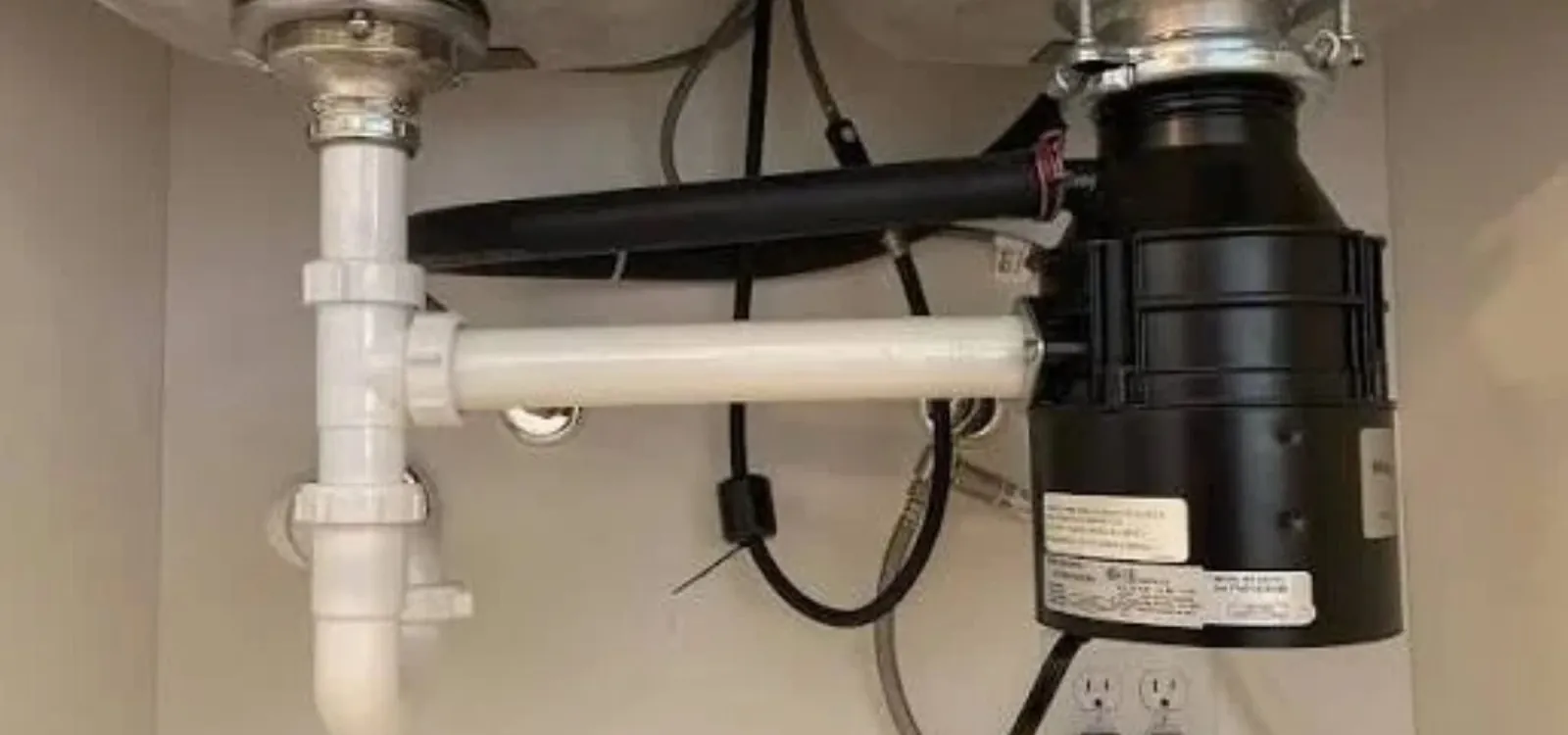
Garbage disposal repair in Willoughby, OH usually starts with one of three sounds: a hum with no spin, a click with silence, or a drip you notice only when you open the cabinet. A disposal is a small motor driving a spinning plate, and a flywheel throws food against a grind ring. When food, a utensil or a failed seal stops that, the unit tells you how.
If water is leaking from the disposal body, switch it off at the wall and close the stops under the sink. Our emergency line runs 24/7, and a flooding kitchen cabinet qualifies. Never reach into the disposal, switched off or not.
Hum, click or silence: what each one means
The sound before the stall is the first clue. Read across before you touch anything.
| What happens | Probable cause | First check |
|---|---|---|
| Hums but the plate does not turn | Jam from a bone, peel or utensil | Power off, then free the flywheel from below |
| Silent, no hum | Tripped overload or no power | Press the reset button, check the outlet |
| Clicks once and stops | Seized motor or deep jam | Try the hex wrench, then call |
| Runs but drains slowly | Clog in the trap or branch line | Test the sink without the disposal |
| Water leaks from the bottom | Cracked housing or failed seal | Replace the unit |
| Leaks at the top flange | Failed gasket or sink mount | Reseat or replace the mount |
A grinding noise with nothing in the chamber suggests worn bearings, and replacement is usually the answer.
Water pouring out of or under the disposal
A disposal leak is one of the few kitchen problems that gets worse each time the sink runs. The unit sits directly over the cabinet floor, so even a slow drip can swell particleboard and ruin cleaners and stored food. A leak from the housing is an end-of-life sign, because the casing cannot be patched.
Stop running the sink and the dishwasher. A dishwasher drains through the disposal, and its discharge arrives in bursts you will not see. Switch off the wall switch, empty the cabinet, and place a pan or towels below. Call and tell us where the water appears, since a top leak and a bottom leak call for different repairs.
Reading the source
Dry the unit and run only the tap. Water at the sink flange means the mount or gasket. Water at the side hose means the dishwasher connection. Water at the bottom or from the reset button hole means the housing has failed.
Disposal jammed or dripping?
Call and tell us the brand, whether it hums, and where the water shows.
A safe way to clear a jam
Hands stay out of the chamber. Not wearing gloves, not with the switch off. If you must look in, use a flashlight and long-handled tongs or pliers. The manufacturer InSinkErator says plainly not to place a hand in the disposal at any time.
Switch the disposal off at the wall. For a plug-in unit, unplug the cord under the sink. Let the motor cool, because an overheated unit trips its overload protector. Then look at the bottom of the housing.
The hex wrench and reset button
Many InSinkErator models have a socket in the center of the bottom that takes a quarter-inch hex wrench. Working it back and forth frees the flywheel until it spins both ways. The small red reset button on the bottom also pops out when the motor overheats, and pressing it restarts the overload protector.
If the unit trips again at once, stop. A reset that will not hold points to a stuck flywheel, a failing motor or a wiring fault. Pressing reset again and again can damage the motor, so call us instead.
Is it the disposal or the drain?
Standing water in the sink with a working disposal means the blockage is beyond the unit. Grease, rice and coffee grounds harden in the trap and the branch line, and the disposal grinds them into a paste that makes it worse.
We run a sectional cable or hand auger through the trap arm and branch line first. If the kitchen drain clogs every few months, our drain cleaning work uses a push camera to show where it narrows. A video answers whether the problem is the line or your habits.
The city's 2020 sewer overflow report logged two basement backups, and both traced to debris in the line. That is a reminder to test more than one fixture: if the tub and laundry drain slowly too, the problem is not under your kitchen sink.
What a disposal should never see
These are the usual causes of calls.
Grease and cooking oil
It cools in the trap and coats the walls. Wipe pans into the trash before rinsing.
Coffee grounds and eggshell membrane
They pack into a dense paste, not a flowing slurry.
Pasta, rice and potato peel
Starch swells and gels in the trap, especially with a little hot water.
Bones, corn husks and fibrous peels
They wrap the shredder ring or stall the plate.
Utensils, bottle caps and fruit pits
Hard objects jam the unit and can bend the flywheel. Check the sink before turning it on.
When replacement beats repair
A seized motor, a cracked housing or a failed seal on an older unit usually means replace, not repair. A motor or housing repair on an older unit rarely makes sense once labor is counted. A reset button that keeps tripping on an old disposal has the same message.
Replacement is more than swapping the body. We check the sink flange and mount, the discharge elbow, the dishwasher inlet and the cord or wiring. Mounts differ between brands, so a unit you already bought may need a new mounting kit, and we confirm the fit before taking the old one down.
Motor size matters in daily use. A larger horsepower unit handles denser waste, but it takes more cabinet space, so we measure the clearance beneath the sink first.
Electrical work and the plumber's limit
Many disposals plug into a switched outlet under the sink, and we connect and test those. If your kitchen has a hardwired unit, no outlet or a switch that does not work, wiring changes belong to a licensed electrician. We will say so on the phone instead of improvising.
Water and electricity share this cabinet, so we also check for wet outlets and corroded connections before we restore power. If the outlet or cord shows damage, we stop and tell you what to have checked before we turn it on.
Dishwasher hookup and the air gap
A dishwasher usually drains through the disposal inlet, and the factory plug in that inlet must be knocked out on a new unit or the dishwasher will not drain. It is an easy step to forget, and we check it on every install.
Dishwasher drain hoses either loop high under the counter or run through a small air gap fitting on the sink deck. Both prevent dirty water from flowing back into the dishwasher. A gurgling air gap or water spitting at the deck means the drain hose or disposal outlet is partly blocked.
A new disposal or a first installation
Adding a disposal where none exists needs a power source, a mounting flange sized to the drain, and room beneath the basin. Some sinks, such as a double bowl with a divider, adapt better than others. Our plumbing installation crew handles the plumbing side, and an electrician handles any new circuit.
Septic homes are a special case. If your home has a septic tank, ask the Lake County General Health District at 440-350-2543 about disposal use before installing one, since the extra solids add load to the tank.
Pricing for disposal repair and replacement
A reset and a jam clear is a short visit. A new disposal with mounting kit, discharge work and dishwasher connection is a longer one. We give a clear price before work starts, whether you supply the unit or we do.
Repair or replace
A jam clear costs far less than a new unit, but an old disposal may fail again.
The unit itself
Horsepower, grind stages and sound insulation set the fixture price.
Mounting and plumbing
A different flange, a new discharge elbow or tight cabinet space adds time.
Electrical status
Missing outlets or hardwired units may need an electrician, billed separately.
Time of call
Night and weekend dispatch differs from a scheduled visit. Ask when you call.
Insurance note. Homeowners insurance usually covers sudden water damage from a burst line, but not a disposal that wore out or a leak that went on for weeks, so call for your number.
While you wait for us
These steps protect the cabinet and keep you away from the blades.
Switch it off and unplug it
Use the wall switch, then pull the cord under the sink if it is a plug-in unit.
Keep hands out of the drain
Do not reach in to clear a jam. Wait for tongs or us.
Stop the dishwasher
It drains through the disposal. Do not run it until the leak is fixed.
Close the stops if water is pouring
Turn the small handles under the sink clockwise. If water comes from the drain, bucket it out of the cabinet.
Write down the brand and model
The label on the housing tells us what fits and what the reset button sits near.
Rules that apply to disposal work
The Ohio Plumbing Code, which is based on the International Plumbing Code (IPC), sets the trap, the drain connection and the air gap or high loop rules that a dishwasher drain must follow where it ties into a disposal. Unplug the unit or switch off its circuit before anything goes near the chamber, and never reach in by hand.
Disposal questions
Yes. Our 24/7 line takes disposal leaks and floods at any hour. Switch the disposal off, stop the dishwasher, close the stops under the sink and call (440) 468-0237. We tell you the next step on the phone, and we ask whether the water is coming from the top, the side or the bottom of the unit. We cannot promise a time, since it depends on how many calls are ahead of you that night.
A hum means the motor has power but the flywheel is stuck. Switch it off, unplug it, and never put a hand in. Many models have a hex socket underneath that turns the flywheel free. If it will not turn or hums again, call us rather than force it.
On many models it is a small red button on the bottom of the housing, under the sink. If the unit overheated, the button sits slightly lower. Press it only after the unit has cooled, and call us if it trips again the same day. A unit that keeps tripping has a jam or a failing motor, and resetting it will not fix either.
Yes. Give us the model number before you buy, or on the box. We check the flange, the discharge elbow and the dishwasher inlet, and we bring a mounting kit if it is a different brand. We install it but cannot warranty the unit we did not supply.
Water that will not drain is usually past the disposal, in the trap or branch line. A grease clog does this. We clear it with a cable and, if it keeps returning, camera the line. See our sewer line cleaning work if other fixtures back up too.
They are not banned everywhere, but they add solids to the tank. If your home has a septic tank, ask the Lake County General Health District at 440-350-2543 before installing one. A sewer-line page does not apply to septic homes.
Yes. We serve Willowick, Eastlake, Willoughby Hills, Wickliffe and Mentor, as well as Willoughby. Call (440) 468-0237 with your address and the brand of your disposal if you know it, so we plan the right parts. We offer same-day appointments when available, and the 24/7 line covers night leaks in each of those towns.