
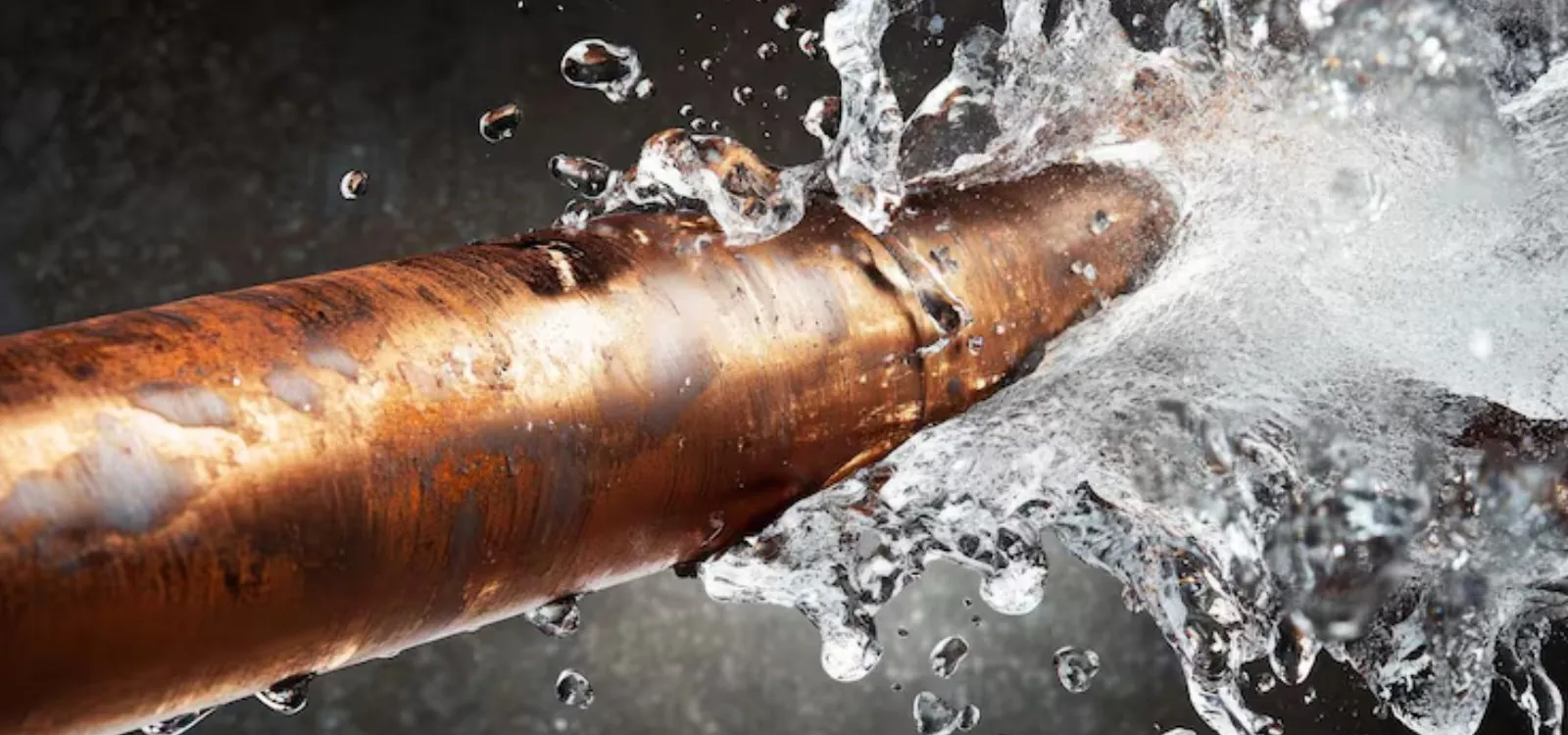
A burst pipe in Willoughby, OH means a section of supply line has split or separated and is releasing water under pressure. A pinhole can drip for weeks, but a true burst can put out many gallons a minute, so the first job is the main shut-off valve, not a phone search.
Once the water is off, call (440) 468-0237. Our emergency line runs 24/7. While you wait, open the lowest faucet to drain the lines, move valuables out of the wet area, and keep the power off in any room where water has reached outlets or the panel.
Most bursts in this area come from freezing, but they also come from old galvanized steel that rusts through, soldered joints that let go, and fittings that were stressed by water hammer. The repair differs for each cause, and the next sections explain how.
Water is spraying or pouring right now
Find the main shut-off, usually where the line enters the basement near the meter, and turn it fully clockwise. A gate valve takes several turns. A ball valve with a lever needs a quarter turn so the handle sits crosswise to the pipe.
If the valve will not move or the burst is upstream of it, call us anyway and also call Lake County Utilities West emergencies at 440-918-3420, which is staffed 24/7. They can advise on the curb stop. Do not force a seized valve with a pipe wrench, because a cracked valve body makes the flood worse.
If water is near electricity, stay out of the room and shut off power only if you can reach the breaker on dry footing. A flooded panel is a job for an electrician after we make the plumbing safe.
In the minutes before we arrive
These steps limit the damage and speed up the repair once the technician is at the door.
Drain the lines
With the main off, open the lowest faucet in the house and the highest one. This lets water out of the pipes so the break stops weeping.
Turn off the water heater
A tank with no incoming water can overheat. Switch an electric unit off at its breaker, or set a gas unit to pilot or off.
Catch and move
Place buckets under ceiling drips, and move furniture, rugs and electronics to dry rooms.
Photograph everything
Take wide and close photos of the damage before you clean up. Your insurance adjuster will want them, and so will we for the repair record.
Keep the pipe visible
Do not wrap or cover the burst section. We need to see the split to judge whether it is a one-spot failure or a sign of pipe that is failing along its length.
Water still running?
Tell us where it is coming from and what you have already shut off. We will take it from there.
Why pipes split in this part of Ohio
Cleveland-area weather records give a January mean of 29.1 F, with the first fall freeze averaging Oct 28 and the last spring freeze Apr 23. That is roughly six months a year when an unheated wall, crawl space or garage can reach freezing, and Lake County's winter design temperature is 5 F. Homes with pipes on exterior walls or over unheated garages are the usual casualties.
Ice does not burst a pipe at the frozen spot. Water trapped between the ice plug and a closed faucet has nowhere to go, pressure builds, and the pipe wall fails at its weakest point, often a joint or a thin section. The split is therefore found where the pipe was stressed, not always where the ice is.
The same record shows 63.8 inches of snow and 41.03 inches of precipitation a year in the Cleveland area, and Lake County sits in the lake-effect snow belt. A deep cold snap after a mild spell is what catches homeowners who took down their heat tape too early.
Pipe material and how it fails
How a pipe breaks tells us a lot about the rest of the run. A single failure in good pipe is a spot repair. Repeated failures in old pipe are a different conversation.
| Pipe type | Typical failure | What the repair usually is |
|---|---|---|
| Copper | Split along the side after freezing, or pinhole at a soldered joint | Cut out the damaged section and sweat or press in new copper with couplings |
| Galvanized steel | Rust through at threads, or corroded wall that crumbles near the cut | Replace a longer section, because nearby pipe is often thin too |
| PEX | Fitting failure at a crimp ring, or a cut from impact | Replace the fitting or a short run, and check the crimp tooling used on nearby joints |
| CPVC | Brittle crack at an elbow, often after age or a freeze | Cut back to sound plastic and rebuild with proper solvent cement and fittings |
| Polybutylene (gray plastic) | Fitting or pipe wall splits without warning | Patch the leak, but discuss replacing the run, since failures tend to repeat |
We identify the pipe before we price the job, since the material sets the method.
What a repair visit looks like
The sequence is the same whether the split is under a sink or inside a ceiling.
- 1
Isolate and confirm
We shut the supply, drain the section and confirm that the break is the only active leak with a quick pressure check.
- 2
Open only what we must
A small access cut in drywall or a ceiling is made at the break. We use a moisture meter to find how far water traveled, which helps your drying plan.
- 3
Cut out the damaged pipe
We cut back to solid pipe on both sides of the split, because a patch over a weak wall tends to fail again.
- 4
Replace and support
New pipe and fittings go in, with straps that stop pipes from knocking or sagging. Where a pipe froze, we look at why and whether insulation or rerouting will prevent it.
- 5
Pressure test and restore
We bring the line back to working pressure, watch it, then check for drips at every joint. Drywall, paint and flooring are other trades, but we tell you what to ask them for.
Where bursts hide in Willoughby homes
Water takes the path of least resistance, so the stain is rarely above the break.
Exterior kitchen and bath walls
A sink on an outside wall with no insulation behind it is a classic freeze point. Opening the cabinet door on cold nights lets room air reach the pipes.
Attics and crawl spaces
Pipes over unheated garages or in crawl spaces see temperatures well below the thermostat setting. A tiny crack can run into insulation for days before a stain appears.
Outdoor hose bibs
A hose left connected traps water in the spigot, and the freeze splits the pipe behind the wall. The leak shows when you turn the water on in spring.
Basement ceiling runs
Pipes in rim joist areas touch cold concrete and block walls. If the basement ceiling is dripping, the break is often along the perimeter.
Water heater connections
Corroded unions, flex lines and shutoffs fail without any freeze at all. Water at the base of a tank might be a pipe or the tank itself.
Thawing a frozen pipe safely
If a pipe is frozen but not yet split, open the nearest faucet so steam and melt water have somewhere to go. Warm the pipe slowly with a hair dryer, a heating pad or warm towels, working from the faucet toward the frozen section.
Never use a torch, a propane heater or any open flame on a pipe. It can ignite framing and insulation, and it can scald or crack the pipe. If you cannot reach the frozen section, or you see a wet spot forming, shut off the main and call us.
Preventing the next freeze
Lake County Building Department's design table lists about 40 inches of frost depth. That figure is what designers use for burial depth, and it helps explain why a service line that was laid shallow can freeze while the interior plumbing stays fine. If water stops at the tap only in the coldest weeks, the buried run is a suspect, and our water line repair page covers that case.
Inside the house, insulate exposed pipes, seal gaps around penetrations where cold air enters, and disconnect hoses before the first freeze, which averages around Oct 28 for the Cleveland area. Keep the thermostat at 55 F or above when you travel in winter. A trickle from a faucet on the exposed wall moves water and lowers the chance of a plug forming.
When one burst is a sign of aging pipe, patching only buys time. Galvanized runs that have failed twice, or pipe that is rough and pitted when we cut it, may justify replacing the supply lines in that part of the house. We will tell you what the cut shows.
What burst pipe repair costs
Burst pipe jobs range from a simple fitting swap under a sink to a repair inside a ceiling with water damage on two floors. We give you a clear price before work starts, and we explain what sets it so you can compare.
Pipe material and size
Copper, PEX and galvanized each take different tools and parts, and larger diameters cost more to replace.
Access to the break
A pipe under an open sink is easy. One inside a finished ceiling or a closed wall needs more opening and more restoration afterward.
How much pipe is damaged
A single split in new copper is a short cut-out. Old steel that is thin along its length needs a longer replacement.
Time of the call
Emergency dispatch outside normal hours can be priced differently from a scheduled visit. Ask when you call.
Water damage next to the repair
Drying, drywall and insulation are separate from plumbing. We repair the pipe, and you may need a restoration contractor for the rest.
Insurance note. Homeowners insurance often covers sudden damage from a burst or frozen pipe, including the water damage. It usually does not pay to replace the pipe itself or damage from a slow leak, so call your insurer and call us for your number.
What code says about a burst pipe repair
Replacement pipe and fittings must meet the Ohio Plumbing Code, which is based on the International Plumbing Code (IPC), and the material has to be listed for potable water. Repairs that go beyond a small section can need a permit from the building department that covers your address, and we tell you which one applies before work starts.
Burst pipe questions
Yes. The line at (440) 468-0237 is open 24/7, including nights, weekends and holidays. Shut off the main water valve first, then call. We offer same-day appointments when available, and we will confirm the plan for your visit when we talk with you. Do not wait until morning if water is still flowing.
Yes. Once the main is off, the tank can run without fresh water, and an electric element left on in an empty tank can burn out. Switch the breaker off or set a gas unit to pilot. Turn it back on only after the pipe is repaired and the tank is full.
Only if it has not split. Thaw it slowly with a hair dryer or heating pad, then check for leaks as the water starts flowing. If the pipe has cracked, the damaged section must be cut out and replaced, since a clamp or tape is temporary at best.
Watch for warm, bubbled or stained drywall and a meter that spins with everything off. A moisture meter and thermal camera usually narrow it to a few inches. If the source is unclear, our leak detection service uses sound and pressure tests before any wall is opened.
We repair the plumbing and leave the access cut clean. Drywall, paint, flooring and insulation replacement are carpentry and restoration work. We can tell you what the repair record needs to show for your insurer and how long the opening should stay open to dry.