
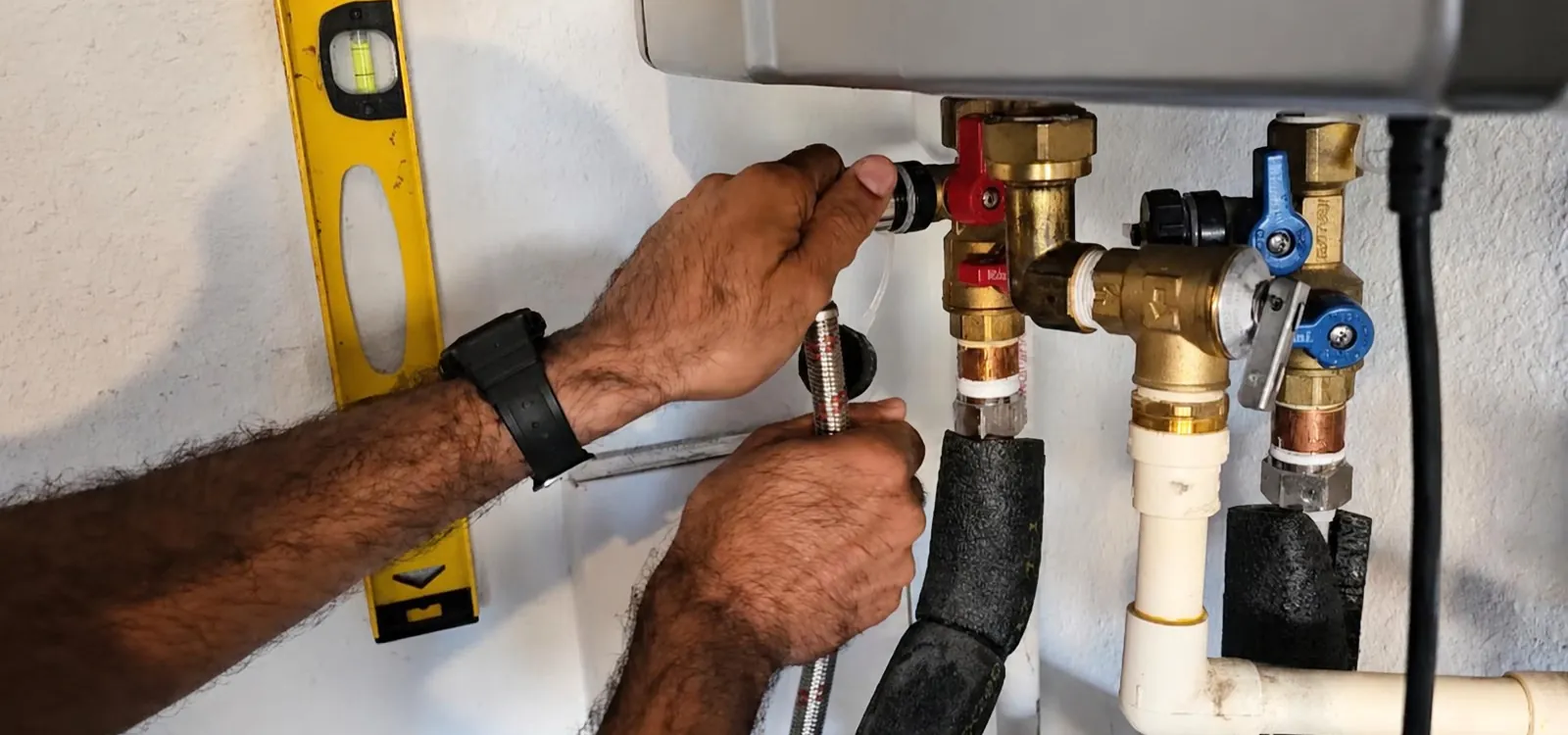
Tankless water heater service in Willoughby, OH starts with a plain fact: the unit heats water as it flows, so scale, flow and gas supply matter more than tank age. We flush and descale units, diagnose error codes and check whether a swap from a tank is practical for your house.
A tankless heater fires a burner only when a hot tap opens and water moves through its heat exchanger. Our 24/7 line takes emergency calls, but most tankless work is planned, and the visit is calm and methodical.
Error codes and what they usually point to
Codes differ by brand, so the unit's manual is the authority. These are the families we see.
No ignition or flame lost
Often a gas supply issue, a dirty flame rod or igniter, or a vent blockage. Repeated lockouts mean stop resetting and call.
Overheat or high limit
Frequently scale insulating the heat exchanger, a failing sensor or low flow. Scale is the first thing to rule out.
Flow or temperature faults
A clogged inlet screen, a failed flow sensor or a plumbing fault such as cross-flow through a mixing valve.
Vent or exhaust faults
A pressure switch tripping on a blocked, kinked or frozen vent termination. Cold months make this more common.
Condensate faults
On condensing units, a blocked drain or neutralizer cartridge can shut the unit down.
Why scale is the maintenance item that matters
Hard water leaves mineral scale on the heat exchanger. The Pacific Northwest National Laboratory notes that scale cuts capacity and efficiency and can eventually cause the exchanger to fail, and that many manufacturers recommend professional yearly cleaning.
Navien says to descale at least once a year, and more often depending on mineral content, temperature setting and household use. It names an approved descaling solution or plain white vinegar, a submersible pump, hoses and a bucket, then a fresh water rinse. It also warns that improper do-it-yourself service can damage the unit and void the warranty.
Lake County's water report does not list a hardness figure, so we do not guess at yours. Call the utility lab at 440-918-3420 or test your own tap, and use that number to set the flush schedule.
Error code or cold water?
Call and read us the code and brand on the front of the unit, and we will tell you what it usually points to.
How a flush is carried out
Steps vary by manufacturer. We follow the unit's manual.
- 1
Power down and isolate
Turn off gas and power, then close the hot and cold isolation valves. Units without service valves need them added first.
- 2
Connect the pump loop
Hoses link a small pump and a bucket to the unit's service ports so the solution circulates through the heat exchanger.
- 3
Circulate the descaler
An approved descaling solution or white vinegar runs through the exchanger for the time the manual specifies.
- 4
Rinse thoroughly
Fresh water flushes the system until no solution remains. We clean the inlet water filter screen at this point.
- 5
Restore and test
Valves reopen, gas and power return, and we run a hot tap to check temperature, flow and code history.
Flush, repair or replace the unit
The right call depends on what the unit is telling you and how old it is.
| Situation | Likely path | What we check first |
|---|---|---|
| Unit is years old and never flushed | Flush, then re-evaluate | Flow rate, temperature rise and exchanger condition after cleaning |
| Repeating overheat or flow codes | Descale, then test sensors | Scale, inlet screen and sensor readings |
| Ignition failures | Repair | Gas pressure, igniter and flame rod, and vent clear of blockages |
| Heat exchanger leaking | Usually replace the unit | Whether the leak is the exchanger or a fitting |
| Another company declined to service it | Assess | Brand, model, parts availability and manufacturer service limits |
We tell you when a manufacturer restricts a repair or voids a warranty for outside service.
Gas, vent and power: the three limits of a tankless install
Tankless units have much larger burners than tanks, often 120,000 to 200,000 Btu per hour against 30,000 to 50,000 for a tank. That is why many need a three-quarter inch gas branch line where a tank gets by with half-inch, and why pipe sizing follows the National Fuel Gas Code. Some models run on half-inch but top out near 150,000 Btu per hour.
Venting depends on the unit type. Condensing units exhaust cool air and can use PVC through a sidewall. Non-condensing units exhaust around 300 degrees Fahrenheit and need a heat-rated vent such as Category III stainless. Condensate is mildly acidic, so many installs add a neutralizer, which needs periodic upkeep.
A gas unit still needs a 120 volt outlet for controls and ignition. A power cut means no hot water unless a battery backup is fitted.
Honest limits on swapping a tank for tankless
A tankless unit does not make hot water faster at the tap. It makes it continuously once flow starts, and some units cannot deliver the low flows from a handwashing or a half-open faucet. Check the manufacturer's stated minimum flow rate.
We will say no to a swap in three cases. The gas line is too small and the meter cannot supply more. There is no workable vent route. Or hot-water demand is low enough that the unit would not pay off. Gas pipe upsizing and chimney work are separate jobs, and we tell you where another trade is needed. See our notes on water heater installation for the planning steps.
Cold Lake County winters and temperature rise
A tankless heater must raise incoming water to the set temperature, usually about 120 degrees Fahrenheit. The required rise is that setpoint minus the incoming water temperature. In the Cleveland area, the January mean is near 29 degrees Fahrenheit, and cold supply in winter means the unit works harder and the maximum flow at a set temperature falls.
Size the unit on the winter case and the practical peak, such as a shower and a dishwasher running together, then check the model's flow-versus-rise chart. A unit sized for July can disappoint in January.
Most residential tankless units are rated under 200,000 Btu per hour. Ohio places heaters above that rating under boiler and pressure vessel rules, so a very large unit changes the regulatory picture.
Heat pump hybrids and boiler-fed setups
Some homes have a hybrid heat pump water heater or an indirect tank fed by a boiler. These are not tankless units, and their service is different. Heat pump units need about 1,000 cubic feet of air space and a room between 40 and 90 degrees Fahrenheit, according to the U.S. Department of Energy.
Boiler-fed systems belong with boiler repair, and hot-water-only problems on a combination setup need the boiler checked too. Tell us exactly what is installed when you call so the right technician comes.
What drives tankless service and swap costs
A flush price differs from a conversion price, and we quote them separately. You get a clear price before work starts.
Isolation valves
Units without service valves need them fitted before a flush, which adds parts and labor.
Scale level
Heavy scale takes more circulation time and may need a repeat treatment.
Brand and parts
Some brands have parts on the shelf and others do not.
Gas and vent changes
Upsizing gas pipe, adding a sidewall vent or a neutralizer adds materials and time.
Water treatment
A water softener or filter can slow scale and reduce flush frequency.
Insurance note. Homeowners insurance does not cover scale buildup or normal wear on a tankless unit, though sudden water damage from a leak can be covered, so call for your number.
Safety steps and code points for tankless units
Gas tankless units need correct venting under the manufacturer's listing and the National Fuel Gas Code, NFPA 54, and the water side follows the Ohio Plumbing Code, which is based on the International Plumbing Code (IPC). Do not run a unit with an error code that points to the vent or flame, and shut off the gas if you smell it.
Tankless questions
Navien says at least once a year, and more often with hard water or heavy use. Because Lake County's report lists no hardness figure, we suggest testing your tap or calling the utility lab at 440-918-3420, then setting the schedule from that number. Without isolation valves a flush cannot be done properly.
Manufacturers describe vinegar or an approved solution, a pump, hoses and a rinse. They also warn that mistakes can damage the unit or void the warranty. You need isolation valves, the right hose connections and a thorough rinse. We recommend a trained technician, and your manual is the final word.
Often we can look at them, depending on brand and parts availability. Call with the brand, model number and the error code on the screen. We tell you plainly if a manufacturer limits warranty work or if the unit has reached the point where replacement is more sensible.
It depends on household size, gas line capacity, the vent route and your tolerance for yearly maintenance. Winter incoming water is cold, so size matters. We assess the gas, vent and demand before suggesting a swap, and sometimes a new tank is the better answer.
Common causes are a clogged inlet screen, scale in the heat exchanger, a failed sensor or a minimum-flow shortfall when only a little hot water is used. Cross-flow from a bad mixing valve elsewhere can do it too. A technician checks flow, temperature rise and error history to isolate the cause.
The 24/7 line takes urgent calls such as leaks and complete loss of hot water. We serve Willoughby and nearby towns, including Mentor. If you smell gas, leave the building and call the gas utility or 911 before calling us.