
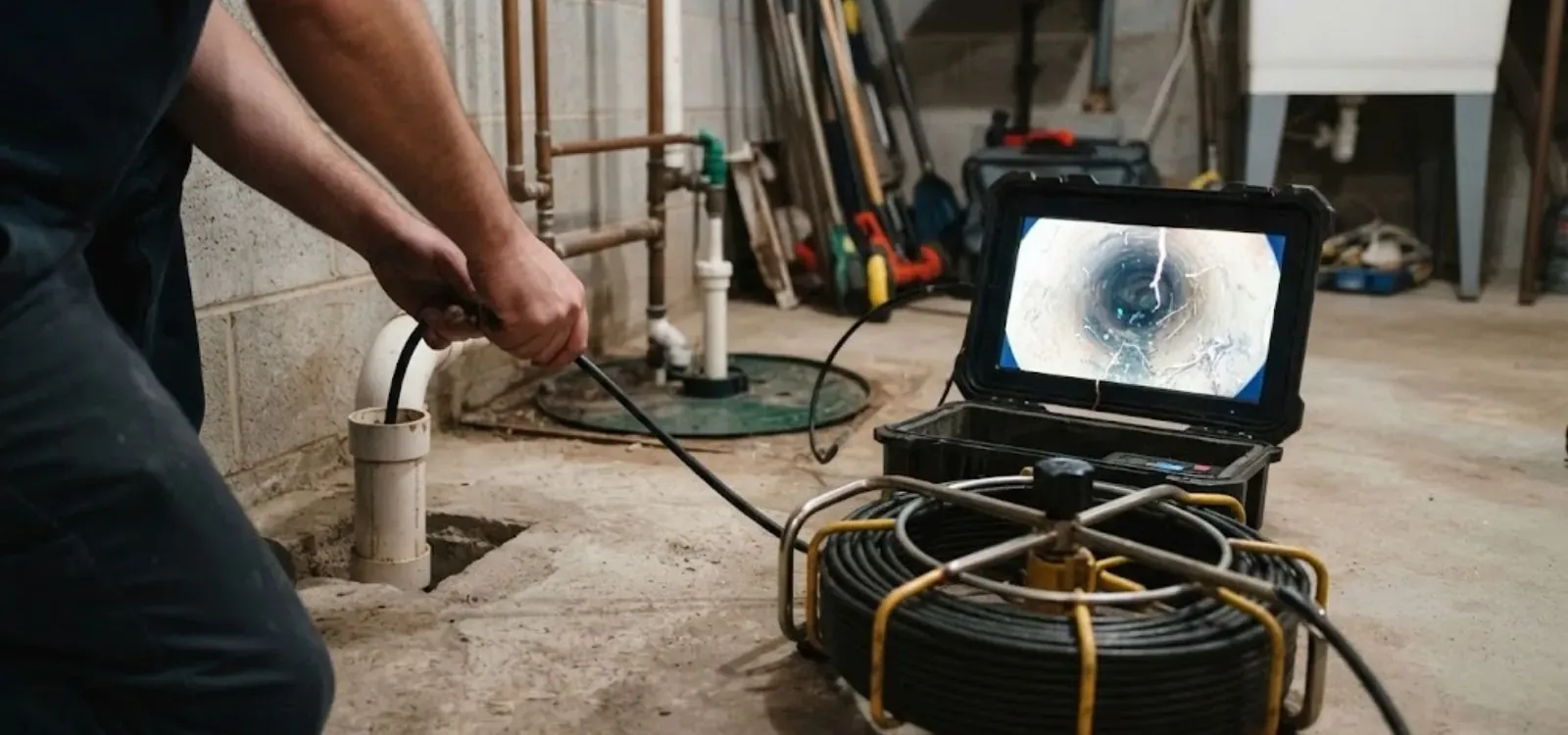
A sewer camera inspection in Willoughby, OH sends a small waterproof camera through your sewer lateral and records what it sees. You get a look at the pipe material, roots, sags, cracks and joints that no one can judge from the surface.
Most people book one for a reason: a house purchase, a clog that keeps coming back, or a repair quote they want to check. It is a planned visit, not a rescue. If water is coming up in the house right now, our 24/7 line comes first, and we can scope the pipe after it is open.
Good reasons to put a camera in the line
You are buying an older house
A home inspector checks the visible plumbing. The lateral underground is outside what they can see, and it can be the most expensive surprise in the house.
A clog keeps returning
If a cable clears the line and the backup returns, something in the pipe is catching debris. The camera finds it.
A repair quote needs a second look
Someone told you the line needs digging or lining. A recording lets you confirm, compare quotes and avoid paying for the wrong scope.
A sewer smell with no clear source
A cracked pipe, a dry or broken trap or a sagging section can all produce odor. The camera tells you which.
A lawn that stays wet or sinks
A soggy patch over the lateral path or a dip in the ground can mean a break below. A locator pinpoints where.
What happens on the day
We start at your cleanout, or at a pulled toilet or accessible vent if there is no cleanout. A flexible rod with a camera head goes into the line. The rod is marked with footage, and a transmitter in the head sends a signal we can follow above ground.
As the camera travels toward the street, we narrate what appears on the screen, record video and note distances to anything notable. Where a problem shows, the locator gives us the depth and position on the surface. That is the number that tells an excavation crew where to dig and tells you how far from the house the trouble is.
Most visits end with a plain summary on site and a recording you can keep. If the line is full of standing water, the camera is stopped at the dip, and we discuss whether cleaning first is needed.
Planning a purchase or a repair?
Call (440) 468-0237 to schedule a camera visit and tell us what the pipe has been doing.
What the camera shows and what it cannot
| Finding | What it looks like | What it means for you |
|---|---|---|
| Roots | Fine hairs or thick masses at joints | Joint is open. Cleaning gives relief, a repair ends the cycle |
| Belly or sag | A dip that holds standing water | Debris settles there. Often needs repair if deep or long |
| Offset joint | Pipe ends do not line up | Catches paper and roots. Repair is usually needed |
| Crack or break | A line or gap in the wall, sometimes soil visible | Needs repair. Cleaning only delays it |
| Scale or grease | Rough, narrowed wall | A jetting job, not a repair |
| Pipe material | Plastic, clay, cast iron or fiber | Guides what tools are safe and what a repair costs |
A camera cannot see outside the pipe. It shows the inside wall, not the soil condition or how much of the lawn would have to be opened.
Looking at a lateral before you close on a house
Lake County has a lot of mid-century housing. Willowick's median home was built in 1957, and more than half were built in the 1950s. Wickliffe's median is the same year. Pipes laid then may be clay or cast iron, and joints loosen over decades.
A seller's disclosure may say nothing about the underground line because the seller never looked. A camera visit before closing gives you the footage to use in negotiation, whether that means a repair credit, a lower price or a decision to walk.
Ask Willowick or Wickliffe whether a point-of-sale inspection applies before you make an offer, since rules vary by town. A camera does not replace any city requirement, but it shows pipe condition, which a dye test does not. Our Willowick plumbing page explains more about that housing.
From footage to a decision
A recording means little until someone translates it into a plan.
- 1
Review the footage with us
We play the key moments and show where the line has trouble. You see the same view we do.
- 2
Sort findings into maintenance and repair
Scale and grease are maintenance. Open joints, cracks and sags are repair questions. They are different budgets.
- 3
Get the location in writing
Depth and distance from the cleanout go in your notes. Without them, a repair estimate is only a guess.
- 4
Choose cleaning, repair or watching
A pipe in fair shape may only need cleaning on a schedule. A pipe with a clear defect needs a repair plan.
- 5
Share the recording
You can show it to an insurer, a buyer's agent or a second contractor. It belongs to you.
Locating the line before anyone digs
A locator finds the route and depth of your private sewer lateral, but it does not find the other utilities near it. Ohio law requires excavators to notify OHIO811 at least 2 working days before digging, by calling 811 or 800-362-2764. A homeowner digging their own yard is generally outside that rule, unless the area is an easement or right of way, but calling is still wise.
If the camera shows a break and you plan to dig, give the footage and the locator marks to the excavation contractor. They will still call OHIO811. We locate and record the pipe. Excavation is another trade's work.
Flood history and what it means for a lateral
The Chagrin River gage at Willoughby peaked at 19,100 cubic feet per second in the July 2006 flood, and county records count roughly 100 homes destroyed and 800 severely damaged across Lake County. Major flooding is documented along the Chagrin from Willoughby Hills to Eastlake.
Water-saturated ground and floodwater pressing on a pipe can leave loose joints or silt inside a line. If your home sits in a low area near the river and has had basement water, a camera pass is a reasonable check even without a clog. It tells you whether the lateral came through intact, and that answer helps you decide about a backwater valve or a repair.
Willoughby code also bars tying downspouts, sump pumps and foundation drains to a building sewer that connects to the public sanitary sewer, in Section 915.04. If a basement drain only fills during rain, ask a plumber to trace where your downspouts and foundation drain discharge, since a tie-in to the sanitary side would break that rule.
Where a camera pairs with cleaning, jetting or repair
Many visits begin as cleaning. If a technician clears your line, we can push a camera through afterward and show you what caused the backup. See drain cleaning for that route, or hydro jetting when the pipe is coated from end to end.
If the footage shows damage, sewer line repair is the next conversation. Options include replacing a section, lining the pipe or excavating. We explain each one and you decide. If an old downtown building is involved, the age of the plumbing is worth mentioning at the start of the visit, since the historic district around Erie and River Streets has many structures that predate modern pipe.
What shapes the price of a camera inspection
The price depends on the line, not just the machine. A short lateral with a cleanout is a simpler visit than a long run with no access. We give you a clear price before work starts.
Length of the line
A longer run means more cable and more time recording.
Access
A cleanout is the easy way in. Pulling a toilet or reaching a vent adds steps.
Cleaning needed first
If grease or debris blocks the camera, the line must be cleaned before it can be inspected.
Locating and marking
Tracing the line above ground and marking defect locations adds time but gives you a map.
Written findings
A summary for a buyer, insurer or contractor takes preparation beyond the recording.
Insurance note. Homeowners insurance generally does not pay for an inspection requested by a buyer or out of curiosity, though an insurer may ask for one after a claim, so call your agent and call for your number.
Standards behind a sewer camera report
A camera inspection records the condition of the line, but repair decisions follow the Ohio Plumbing Code, which is based on the International Plumbing Code (IPC), and the sewer authority that owns the main. The lateral from the house to the connection is usually the owner's responsibility, so the video has real value when you plan a repair or a sale.
Camera inspection questions from Willoughby homeowners
Yes. The camera head carries a transmitter, and a locator above ground picks up its signal. We mark the route and the depth on the surface, plus any defect we find. That keeps a repair crew from guessing, and it helps you plan landscaping or fencing.
Camera inspections are scheduled visits, with same-day appointments when available. If sewage is backing up now, call the 24/7 emergency line at (440) 468-0237. We clear the line first, and a camera pass can follow once water is moving normally again.
Yes. You can show it to a buyer, an insurer, a city office or another contractor. Ask us to note the footage distance for each finding, since those numbers are what repair estimates start from, and keep a copy with your house records.
A full clog, a collapsed section or a hard offset can stop it. We note the distance where it stopped, which is itself useful information. Depending on what we see, the next step may be cleaning or a different access point.
Not automatically. A cable clears the clog. A camera adds a look at the cause. We recommend it when a clog repeats, when the cable keeps stopping at one spot, or when you are buying or about to pay for a repair.
Yes. A camera inspection covers a sewer lateral that runs to a public sewer. If your home has a septic tank instead, ask the Lake County General Health District at 440-350-2543 who inspects and permits septic systems, and what a septic buyer should have checked.
The camera shows where the problem sits, measured by distance from the house. Whether that spot belongs to you or the city is a question for the City of Willoughby sewer division, reachable through City Hall at 440-951-2800. The footage gives them something specific to work with when you call.