
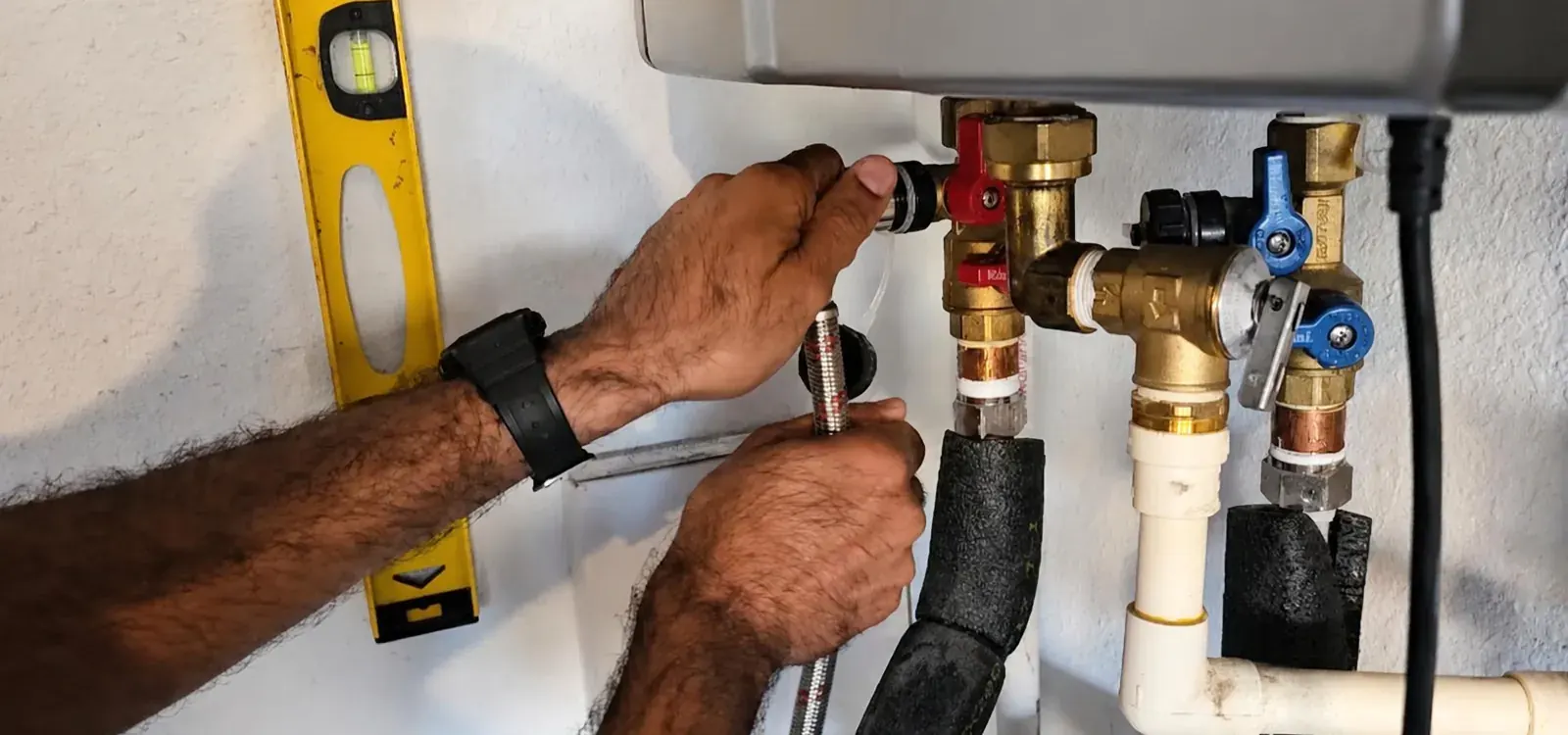
Sometimes. Tankless units heat water on demand, but manufacturers still say a closed water system needs a way to control thermal expansion. A closed system is one with a backflow preventer or a check valve that stops water from pushing back into the street main.
If your Willoughby, OH house has one, a tankless heater may need an expansion tank on the cold supply. If it does not, the tank is usually not the fix. A plumber can tell you which you have in a short visit.
A closed system, in plain terms
Water expands when it is heated. In an open system, that small extra volume simply backs up into the city main through the meter. In a closed system, a one-way device blocks that path.
With nowhere to go, pressure inside the house plumbing rises each time hot water is made. Fixtures, joints and the relief valve take the strain. The usual symptoms are a relief valve that drips after hot water use, faucets that spit, and fittings that wear early.
What the manufacturer manuals say
These notes come from the installation manual for Rinnai's N Series condensing tankless units and an owner's manual for State Water Heaters expansion tanks. Your unit's own manual is the document that governs your install.
| Topic | What the manual states | What it means for you |
|---|---|---|
| Closed supply system | Rinnai says a heater on a closed system, such as one with a backflow preventer in the cold line, needs a means to control thermal expansion | Find out if you have a backflow device or check valve |
| Who to ask | It says to contact the water supplier or local plumbing inspector on how to control expansion | Ask the utility and the building department, not a store clerk |
| Dripping relief valve | Rinnai says periodic discharge may be thermal expansion in a closed system, and not to plug the valve | A drip is a symptom to diagnose, not to cap |
| Sealed hot water systems | State Water Heaters says a sealed system needs an expansion tank or the relief valve will discharge every heating cycle | The tank is a cure for that specific condition |
| Tank type | State Water Heaters says not to use a standard tank | Use a potable-rated diaphragm expansion tank |
| Air charge | State tanks ship precharged to 40 psi and the charge needs to match incoming pressure | Have the tank checked with a gauge at installation |
The Rinnai manual does not say every tankless install needs a tank. It says closed systems need a method of control.
Not sure if you have a closed system?
Call (440) 468-0237. We can look at your meter area and tell you what the manual and inspector will want.
Why tankless does not get a free pass
A tank heater stores tens of gallons, so people assume tankless units skip the problem. The manufacturer does not agree. Rinnai's tankless manual carries the same closed-system language as a tank heater manual.
The reason is simple. Pressure rises from heated water in the piping and the heat exchanger, and the house still has the same sealed supply. The effects can show up as relief valve discharge or pressure swings in the house.
How to find out if your home is a closed system
None of this needs tools beyond a flashlight and a pressure gauge, but a plumber should confirm what you find.
- 1
Look near the meter
Find where the water line enters the house and look for a device near the meter or after the main shutoff. Some meters have a check valve built in.
- 2
Check for a pressure reducing valve
A bell-shaped brass valve on the main line usually means a pressure reducing valve. Some versions create a closed system if they have no bypass.
- 3
Read the pressure
Attach a gauge to a hose bib with no water running, then run hot water and watch the needle. A rise after heating points to expansion.
- 4
Ask the supplier
Water suppliers can say whether a backflow or check device is part of your service. Rinnai's manual says to contact the water supplier or the plumbing inspector.
- 5
Let a plumber size the fix
If expansion control is needed, the plumber selects a potable-rated tank, sets its air charge to your pressure and plans where it hangs on the cold line.
What Willoughby and Lake County paperwork lists
Ohio's cross-connection rule, OAC 3745-95-02, bars cross-connections unless the supplier is satisfied they are controlled and requires each public water system to run a cross-connection control program. Backflow devices can be one result, and they are one way a house ends up closed.
The Lake County Building Department's 2026 residential permit schedule lists expansion tanks and backflow devices as permit items, along with a water heater only line. That schedule covers county communities such as Willowick and Willoughby Hills, but it does not cover the City of Willoughby, which issues its own plumbing and gas piping permits through the Division of Building Inspection. Ask your building department what it wants for a tankless install with an expansion tank.
Source: Ohio Administrative Code 3745-95-02, Lake County Building Department 2026 residential plumbing permit schedule, and City of Willoughby Division of Building Inspection permit forms
Tankless installs that bring their own checks
A tankless install is not just a heater swap. Gas line sizing, venting, condensate disposal and the relief valve piping all come into the job. A closed-system check belongs on that list, and it is easy to do while the walls are open.
The relief valve on a tankless unit still needs a discharge pipe routed to a safe place, with no other valve between it and the heater. Plan the tank location before the heater goes up, because the cold line needs room for a tee and support. Any sound tankless water heater job includes that check before a unit is sized.
When the tank fixes nothing
If the relief valve drips because of worn parts, high street pressure or a scaled seat, an expansion tank will not cure it. A plumber who starts by reading pressure before and after a heating cycle avoids buying parts for the wrong problem.
Replacing a tank heater with a tankless unit
A tank to tankless conversion is more than a heater swap. The gas supply often needs a larger line, the vent changes, and the unit needs an electrical supply. If a tank heater used an expansion tank, it may stay on the cold line when you convert, or it may be moved.
The expansion tank often outlives the old heater, so ask the plumber to test the air charge during water heater installation. State Water Heaters notes that its tanks eventually leak, so mount one where a leak will not do damage and where it will not freeze.
Two things never to do
Do not plug or cap a dripping relief valve to stop the water, and do not buy an undersized tank because it fits the shelf. Rinnai's manual says not to plug the pressure relief valve, and the State Water Heaters manual says to use a tank sized from its chart.
Leave the sizing and permit questions to the plumber and the building department, since the correct tank depends on your pressure, your piping volume and your inspector.
Tankless and expansion tank questions
No. Manufacturers require a means of controlling thermal expansion when the supply is a closed system. If your house is open to the street main, a tank is usually not needed. A plumber can check your meter area and read your pressure to say which applies.
If it drips only after hot water has been made, expansion is a strong suspect. A pressure gauge on a hose bib shows whether pressure climbs after a heating cycle. Do not cap the valve, and have a plumber confirm the cause.
The City of Willoughby's Division of Building Inspection issues plumbing and gas piping permits for the city. Lake County's schedule lists expansion tanks as permit items for county communities, but it does not cover the city. Ask City Hall at 440-951-2800 what it wants.
In Mentor, water comes from Aqua Ohio, not Lake County Utilities, so a backflow question there goes to Aqua Ohio. The City of Mentor building division handles permit questions. A plumber can read pressure inside the house to tell you what type of system you have.
The hardware is simple, but the sizing, the air charge and the permit are not. A wrong charge makes the tank useless. A tankless job also involves gas and venting, which are not homeowner tasks, so book a licensed plumber.
Still have a question?
Call the 24/7 line and a person answers.