
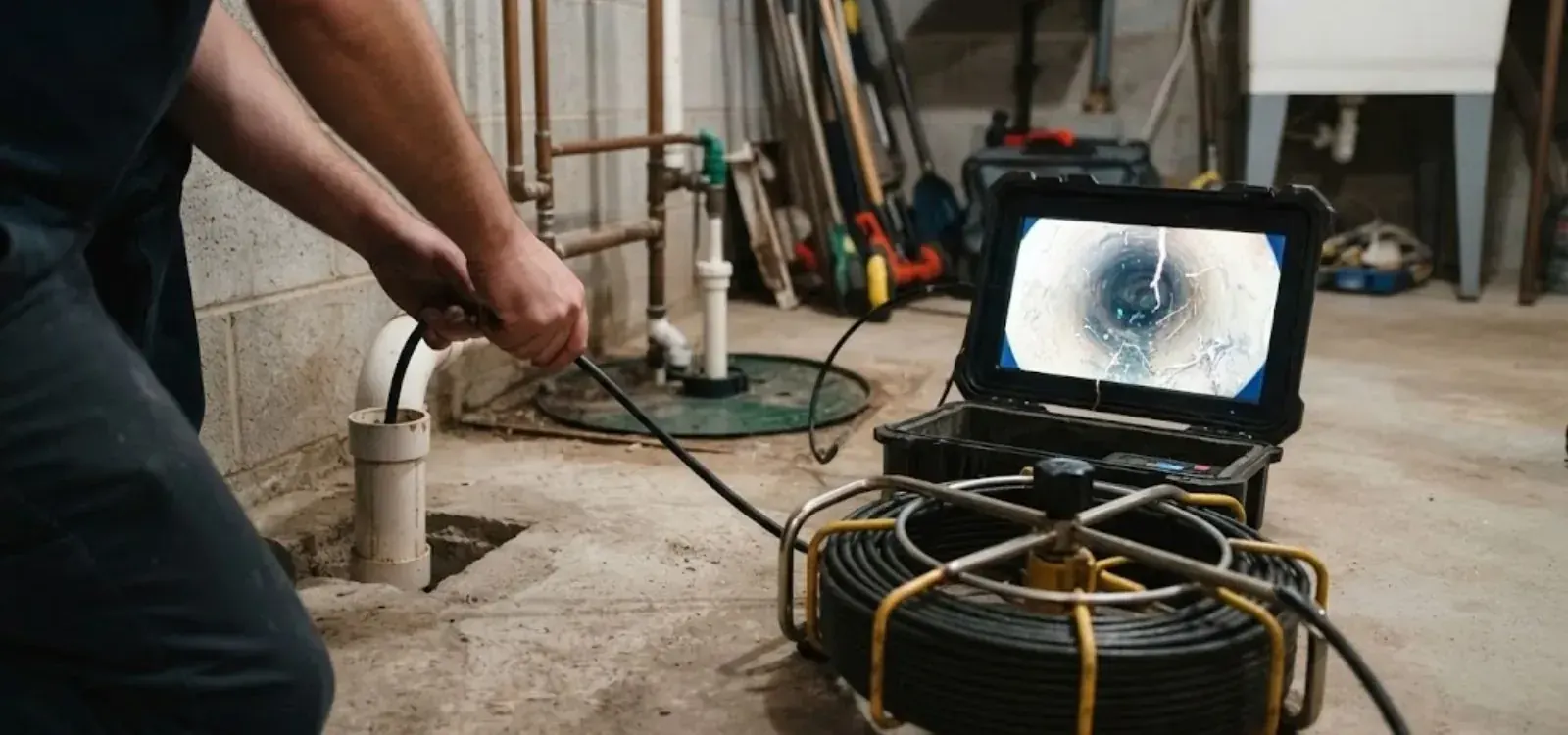
A sewer camera inspection in Willoughby, OH sends a small waterproof camera down your main drain line from a cleanout or vent stack. It records roots, cracks, sags, offset joints, buildup and breaks, and a locator tells the technician how deep each problem sits and how far it is from the house.
For a home buyer the answer is simple. Yes, scope the line before closing if the house is decades old or has big trees nearby, because the pipe is buried and the seller may not know what is in it. The footage gives you a defect list you can use in negotiation.
What the camera actually sees
The head of a push camera is about the size of a large coin and carries its own lights. It rides on a stiff, flexible cable that the technician feeds in through a cleanout, a pulled toilet or a roof vent. A transmitter in the head lets a handheld locator above ground find the exact spot, which matters when you need to dig. We cover Wickliffe jobs the same way.
What shows on screen depends on the pipe. Clay and cast iron tend to show root hairs at joints and flaking along the bottom. Plastic pipe shows sags, called bellies, where the trench settled and water now sits instead of draining. Every pipe can show a crack or a collapsed section.
The camera cannot see through full pipe. If the line is plugged, the technician usually has to clear it first with a cable or a hydro jet, which is a separate job that the sewer line cleaning page explains.
How the visit goes, start to finish
Most scopes are done in one trip, and the buyer or seller does not have to be home the whole time.
- 1
Find the access point
The technician looks for a cleanout near the foundation, in the basement floor or at the property line. If none exists, a toilet is pulled and reset afterward.
- 2
Run clear water
A little water through the line helps the camera lens stay clean and shows where it flows or pools.
- 3
Push toward the street
The camera is fed along the line while the monitor records. The footage counter shows distance in feet from the entry point.
- 4
Mark every defect
At each crack, sag or root mass the technician stops, notes the distance and uses the locator to mark the surface and read the depth.
- 5
Review the video with you
You watch the problems on screen, hear what is minor and what is not, and get the recording so you can send it to your agent or a repair contractor.
Scoping a house before closing?
Call (440) 468-0237 to talk through timing with your inspection window.
Common findings and what each one means
| On the screen | What it usually means | What buyers do with it |
|---|---|---|
| Fine root hairs at joints | Roots found a tiny gap and are feeding on it | Plan on periodic cleaning, ask about a repair if it is heavy |
| Belly or sag with standing water | Soil settled under the pipe | Ask for a repair credit, because debris collects in a belly |
| Longitudinal crack | The pipe wall split along its length | Get a repair quote before closing, since cracks tend to widen |
| Offset or separated joint | Two pipe sections have shifted apart | Expect a spot repair or lining, depending on length |
| Collapsed or missing section | The pipe is broken and soil is entering | Treat as a major repair and negotiate price or walk |
| Clean, smooth pipe with good flow | No visible defects on the day | Keep the video as a baseline for later |
A clean scope is a snapshot of that day, not a promise about the next ten years.
Why buyers scope the line before closing
A standard home inspection looks at the fixtures and the visible drains. It does not see the buried line between the foundation and the public sewer. That stretch is often the most expensive part of the plumbing to fix, so it is worth seeing before the contingency period ends.
Scope the line if the house is older, if mature trees stand over the lateral, or if the seller mentions slow drains. Also scope it if the basement has a floor drain that has backed up. A recording from the day of inspection protects you if the seller later says the line was fine.
Ask the technician to read the footage counter at each defect and note the cleanout location. That gives a contractor enough to quote a repair, which the sewer line repair page covers in more detail.
What a scope does not do
A camera does not test for leaks under pressure, check the vents, or certify the line for the city. It also cannot tell you whether the pipe belongs to you or to the city past the property line, so ask the sewer division before you assume.
If the technician sees something that needs a dig, the next step may be an excavation contractor or a permit from the city, and the plumber should say so plainly.
Point of sale in Willoughby: what to ask
One title agency's Lake County list shows the City of Willoughby requiring a point-of-sale inspection for smoke and carbon monoxide detectors, with no sewer or water item. We did not find a city ordinance that requires a sewer lateral inspection at sale, so ask the city before you list.
Call City Hall at 440-951-2800 and ask what is required for your address. Rules differ by town. The same title agency list shows a dye test and inspections for Willowick, so ask your own city before listing and do not assume one set of rules covers every Lake County address.
Even where no sewer check is required, a seller can scope the line first. Finding a root problem before listing gives you time to fix it on your terms instead of in the middle of a buyer's deadline.
What the city's own sewer records say about Willoughby backups
The City of Willoughby's Division of Storm and Sanitary Sewer Repair and Maintenance looks after the public sewer collection system, and the Willoughby-Eastlake Water Pollution Control Center on Erie Road in Eastlake treats the flow. That means the main under the street is not yours. Where the city's part ends and yours begins on the pipe to your house is something to ask the city about by address.
The city's 2020 sewer overflow report logged two basement backup reports for the whole year. Both were traced to debris in the line, a toilet paper blockage on Kirtland Road and a surcharged manhole near Crossbrook and Tamarac. For you, the lesson is that a backup is not always a cracked lateral, so a camera run helps separate a house problem from a main problem before anyone pays for a dig.
Source: City of Willoughby Codified Ordinances Sec. 135.08 and the City of Willoughby 2020 Sanitary Sewer Overflow Annual Report
Roots, sags and Northeast Ohio ground
The Chagrin River watershed has clayey, poorly drained glacial soils, according to the Chagrin River Partnership's watershed plan. Clay holds water against a buried pipe and swells and shrinks with the seasons, which stresses joints. Lake County's winter design temperature is 5 degrees F, and frost depth is about 40 inches according to Lake County Building Department's design table.
That ground movement is one reason sags and offset joints appear. The practical point for a buyer is to look hard at the footage near the foundation and near the street connection, where the pipe changes direction and the soil is most disturbed.
Sewer camera questions we hear in Willoughby
No. The head is small and rounded, and the cable is flexible. A technician stops when the camera meets a blockage or a break, because forcing it could snag. If the line is badly broken or full of debris, the visit may turn into a cleaning job first, and the footage is taken after the line is clear.
Often yes, if you are buying. Newer plastic pipe can still sag if the trench settled, and a builder's crew can leave debris or a bad joint behind. A short scope is small money next to a surprise repair. Call for your number and ask whether the age of the home changes the plan.
Ask before the visit so there is no confusion. A recording is the whole value for a buyer, because it lets your agent, a second plumber or an excavation contractor see the same defects. Keep the file, along with the distances noted for each problem, with your closing documents.
We did not find a city ordinance that requires a sewer lateral inspection at sale. One title agency's list shows a city point-of-sale inspection for smoke and carbon monoxide detectors. Call City Hall at 440-951-2800 to confirm what applies to your address before listing.
It depends on the town and sometimes on the street. The city or county owns the main, and the homeowner often owns the lateral up to a point. Ask the sewer division for your address, then bring that answer to the plumber. If you are on septic, a sewer scope does not apply, and the Lake County General Health District at 440-350-2543 is the right call.
A cheap borescope can look into a cleanout, but it will not travel far or find depth. It also gives no locator reading. For a house purchase, a pro push camera with a locator is worth using, since the location of a defect decides whether a repair is a short dig or a long one.
Still have a question?
Call the 24/7 line and a person answers.