
Drains in Willoughby, OH clog for a handful of repeatable reasons: cooled cooking grease, hair bound with soap, tree roots entering joints, wipes that do not break up, mineral and soap scale, and old pipe that has sagged or cracked. Each one blocks the pipe differently, so each one behaves differently in your house.
The fastest clue is location. If only one sink or tub is slow, the blockage is in that fixture's branch. If several fixtures gurgle or the lowest drain backs up, the problem is further down, in the main line. That difference decides whether a plunger is enough or you need a plumber.
Six ways a pipe closes up
Most blockages are one of these, and several often work together.
Grease and cooking fat
Hot fat runs down a kitchen drain as a liquid, then cools and sticks to the pipe wall. Each rinse adds a layer, and food scraps stick to it, so the opening narrows until water stops.
Hair and soap
Hair snags on the pop-up stopper or a rough pipe joint and binds with soap scum into a dense mat. Bathroom sinks and tubs clog this way.
Tree roots
Roots follow moisture and enter through joints or cracks in underground lines. Once inside they thicken and catch paper and debris.
Flushable wipes
Labeled flushable wipes are built to stay intact. Toilet paper dissolves, but wipes tangle on rough spots and catch more material behind them.
Mineral and soap scale
Soap residue and mineral deposits narrow a pipe slowly over years, so a drain that was fine becomes slow without any single event.
Broken or sagging pipe
A belly in an old line holds standing water that collects solids. A cracked or offset joint catches debris and gives roots a way in.
Grease: why hot water does not fix it
How the blockage forms
Pouring boiling water after fat feels like it helps, but it only moves the grease further down the line. Past the trap, the pipe cools and the fat solidifies again, often at a joint or bend. That is why a kitchen sink that seems cleared comes back a week later.
What clears it
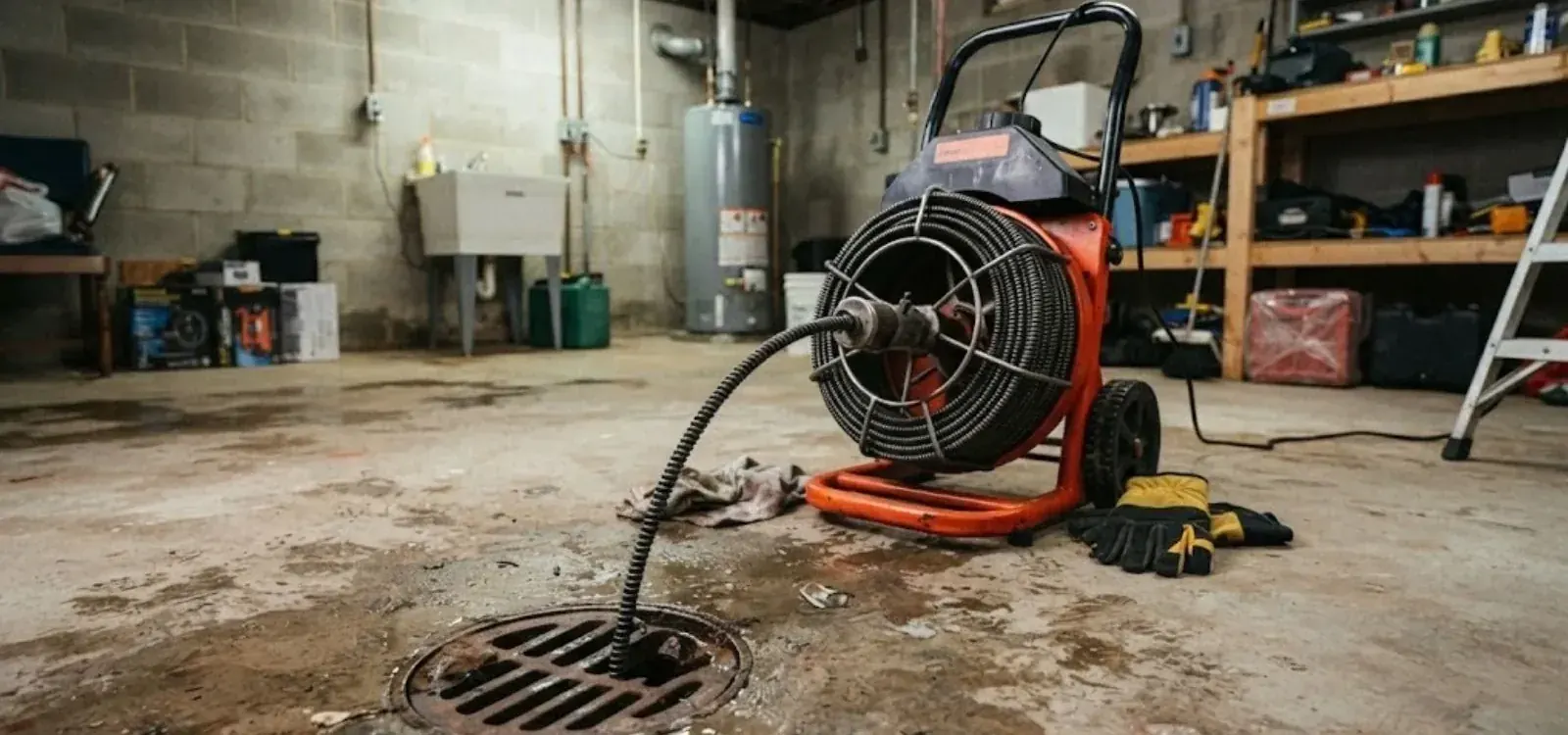
A drain cable breaks and pulls a clog out, but grease coats the pipe wall and can leave a narrower channel behind. When a kitchen line keeps returning, a technician may suggest hydro jetting, which uses high-pressure water to scour the pipe wall instead of poking a hole through the middle.
Not sure which clog you have?
Call (440) 468-0237 and describe which fixtures are slow or backing up.
Hair, soap and the bathroom branch
Bathroom clogs usually sit within a few feet of the drain opening, in the trap or just beyond it. A plastic drain strip or the stopper mechanism can pull most hair out without chemicals. That is the first thing to try before anything harsher.
Liquid drain openers are a poor choice for standing water. They can sit in the pipe and attack fittings, and they are a hazard to whoever works on the drain next. If one has been used, tell the plumber, because they will wear gloves and eye protection.
Which clog matches your symptoms
| What you see | Likely cause | Where the blockage sits | First step |
|---|---|---|---|
| One bathroom sink drains slowly | Hair and soap | Trap or short branch | Clean the stopper, then plunge |
| Kitchen sink slow, smells greasy | Fat buildup | Past the trap, kitchen branch | Stop pouring fat, call if it recurs |
| Toilet and tub gurgle together | Main line restriction | Shared lower line | Stop using water, call |
| Basement floor drain bubbles | Main line blockage or roots | Underground main | Stop water use, call |
| Backup returns every few months | Roots or a sagging pipe | Specific section of the main | Camera inspection |
| Slow drains, white crust around fittings | Scale | Throughout the branch | Plumber assessment |
When two or more fixtures misbehave at once, treat it as a main line problem.
Roots, wipes and the underground line
A tree root entering a joint is a plant doing what plants do. It finds moisture and follows it. Fine root hairs enter first, then thicken, and a blockage that returns every few months is often a root mass that was cut but never removed.
A sectional machine with a cutting head can clear roots, and a push camera with a locator can show where the intrusion is and how far down the line it sits. That locator tells you the depth, which matters if the pipe later needs excavation.
Wipes behave differently. They do not dissolve, so they stack at rough spots, root entries, and bends. The label on the package does not change what the municipal system sees. Keep wipes, paper towels, and feminine products out of the toilet, even when the package says flushable.
What Willoughby's own sewer reports show
The City of Willoughby's 2020 sanitary sewer overflow report lists two basement backup reports for the year, both coded as debris in the line. One narrative reads that a sanitary main was blocked by a buildup of toilet paper on Kirtland Road. The other was a surcharged downstream manhole on Crossbrook and Tamarac Boulevard that the crew relieved by jetting the line.
The practical takeaway is that not every backup starts at your house. If the street has been backing up or a neighbor has the same problem, call the city's sewer division as well as a plumber. Sewer maintenance is handled by the city's Division of Storm and Sanitary Sewer Repair and Maintenance.
City Code Section 915.04 also bans connecting downspouts, sump pumps, foundation drains or areaway drains to a building sewer tied to the public sanitary sewer. Extra clear water in a sanitary line can overload it during heavy rain, which makes small restrictions overflow faster.
Source: City of Willoughby 2020 Sanitary Sewer Overflow Annual Report, City of Willoughby Codified Ordinances, Sections 135.08 and 915.04
Old clay and cast iron lines in older Lake County neighborhoods
Homes built before the 1960s often have clay or cast iron drain lines, depending on the era and the repair history. Clay is made in short sections, so each joint is a place for roots and offsets. Cast iron corrodes from the inside, building rough scale that catches debris.
Willowick's median home was built in 1957, and over half its homes date to the 1950s. Eastlake's median year is 1967. Neither number tells you what is under your lawn, but both mean the sewer service on many lots is old enough to be worth a camera look when problems repeat.
If you live in Willowick or Eastlake, a repeating clog is a good reason to ask for a camera view of the line before another round of cable visits. The picture shows whether you need cleaning or repair.
What a plumber does once you call
The technician starts by asking which fixtures are affected and when it began. A plunger or hand auger handles most single-fixture clogs. For a main line, a cable machine opens the line, and a camera confirms what the blockage was and whether the pipe is damaged.
When the camera shows a sag, a crack or a root-filled joint, cleaning only buys time. In that case the conversation moves to repair options, which is a different job. Cleaning and repair are separate questions, and a straight answer separates them.
A sudden sewage backup into the basement is an emergency. Stop running water, keep children and pets away, and call for sewer line cleaning if the main is the likely cause. Cost depends on access, line length, depth and what the camera finds, so call for your number.
Safety steps before you reach for a drain opener
Do not mix drain chemicals, because the gases can injure you. Do not use them in a line that may be cabled next, and shut off the disposal before you inspect it. Cleanout access and slope are matters for the Ohio Plumbing Code, which is based on the International Plumbing Code (IPC).
Clogged drain questions
Avoid it for standing water or repeat clogs. Chemicals can sit in the pipe, damage fittings, and burn skin or eyes during later service. A plunger, a hair strip or a hand auger works for most single-fixture clogs. If you already used a chemical, tell the plumber before they open the drain.
Watch more than one fixture. If a toilet gurgles when the washer drains, or a basement floor drain bubbles when you flush, the shared line is likely restricted. A single slow sink points to its own branch. When several fixtures react together, stop using water and call.
A cable can open a hole through a blockage without removing the coating on the pipe wall. Roots can regrow, and a sagging section keeps collecting solids. If a clog returns, ask for a camera look so you can see whether cleaning, jetting or repair is the right answer.
Not reliably. Toilet paper breaks apart in water, while wipes are made to hold together and can catch on rough spots or roots. Even products labeled flushable have been blamed for blockages in municipal systems. Put wipes in the trash, not the toilet.
Call the city, whose sewer division maintains the public lines, and a plumber to check your own lateral. Willoughby's sewer is city-run and treated at the joint Willoughby-Eastlake Water Pollution Control Center in Eastlake. A camera view on your side shows whether the blockage is yours or the city's.
Still have a question?
Call the 24/7 line and a person answers.