
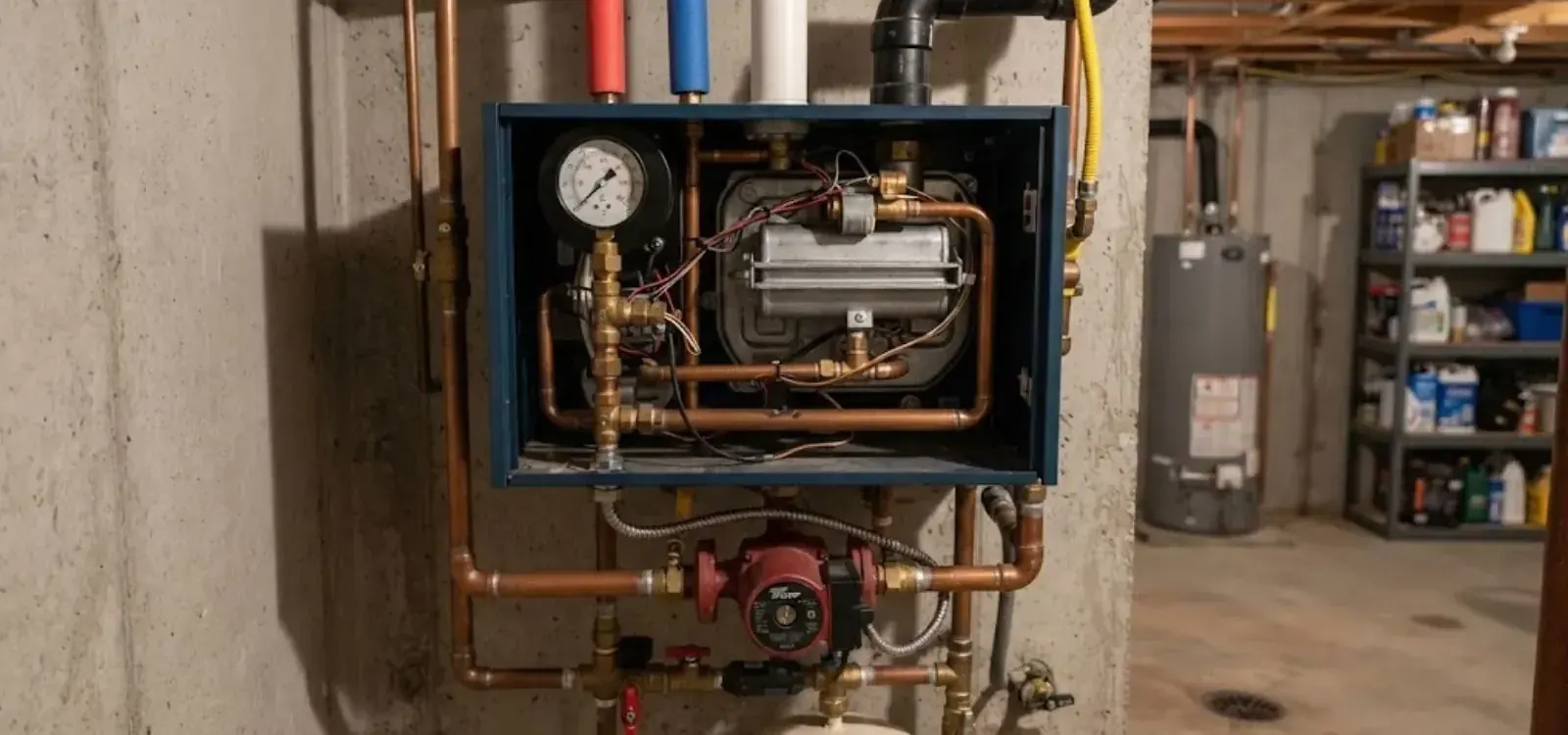
A boiler that is not heating a Willoughby, OH home is usually short of one of four things: a call for heat from the thermostat, electrical power, water pressure in the system, or air-free radiators. You can check each one safely with no tools beyond a flathead radiator key. Work through them in that order, because the first two take under a minute and fix a surprising share of cold houses.
Stop if you smell gas, see water pooling under the boiler, hear banging, or notice soot or scorch marks. A gas odor means leave the building, then call your gas utility's emergency line or 911 from outside. Everything else on this page assumes no gas smell and a boiler that is simply cold.
Four safe checks, in order
Do these before you call anyone, and write down what you see. It helps whoever comes out.
- 1
Make the thermostat ask for heat
Set it to heat mode and raise the target at least five degrees above the room reading. Swap the batteries if the display is dim or blank. A thermostat that clicks but never starts the boiler points to wiring or controls, which is a technician's job.
- 2
Confirm the boiler has power
Look for a light or display on the boiler and a household switch near the stairs that looks like a light switch. Check the breaker panel. Flip a tripped breaker once. If it trips again, leave it off and call, because repeated resets can damage wiring.
- 3
Read the pressure gauge
Find the round gauge on the boiler, often marked in psi. Most home hot water boilers sit at roughly 12 to 15 psi when cold, but your manual gives the real number for your model. Near zero means the system has lost water, and a pressure far above the normal band needs a technician.
- 4
Check the radiators for cold tops
Run a hand across each radiator. If the bottom is hot and the top is cool, air is trapped. If a whole floor is cold while others are warm, a zone valve or circulator may be stuck, and bleeding will not help.
Why a boiler needs pressure and why it drops
A hot water boiler is a closed loop. Water heats in the boiler, a circulator pump pushes it through pipes to radiators or baseboards, and it returns to be heated again. The loop must stay full, or the burner cannot fire safely, which is why a low-water cutoff and pressure controls sit on the system.
Pressure falls when water leaves the loop. A weeping valve, a small pipe leak, a stuck relief valve or repeated bleeding can all do it. Pressure can also look wrong when the expansion tank, which gives heated water room to grow, has lost its air cushion.
A gauge reading tells you something before any repair begins. A steady reading that matches the manual means the loop is probably full. A reading that keeps sliding means water is going somewhere, and finding it is a leak problem.
Checks done and still cold?
Call (440) 468-0237 and describe what the gauge and thermostat showed.
Bleeding radiators the careful way
Bleeding only applies to hot water radiators that have a small valve near the top corner. Steam radiators use a different vent and are not bled with a key. If you are unsure which system you own, look at the manual or the nameplate, or ask before opening anything.
Turn the heat off and let the system cool first. Hold a rag under the valve, turn the key a quarter turn, and wait for air to hiss out. Close it the moment a steady stream of water appears. Then recheck the gauge, because bleeding lets water out and can drop pressure.
Add water only the way your manual describes. If the manual is missing, stop at bleeding and call, since overfilling can open the relief valve.
What you see and what it usually means
Use this as a sorting tool, not a diagnosis. It shows what to check yourself and what belongs to a licensed professional.
| What you notice | Likely cause | Safe check | Who fixes it |
|---|---|---|---|
| No sound, no display | No power or tripped switch | Wall switch and breaker, once | You, or a technician if it trips again |
| Gauge near zero | Water loss from a leak or valve | Look for drips and damp spots | Plumber for leak and refill |
| Radiator hot below, cool on top | Trapped air | Bleed per manual | You |
| Boiler runs, one zone cold | Zone valve or circulator problem | Feel the pipes for heat | Technician |
| Boiler starts, then shuts off | Safety lockout or ignition issue | One reset if the manual allows | Technician |
A lockout that repeats after one reset is the boiler warning you, so do not keep pressing the button.
If you smell gas, do not troubleshoot
Natural gas has an added rotten-egg odor so people notice leaks. If you smell it near the boiler or anywhere in the house, do not touch switches, do not use a phone inside, and do not try to relight anything. Leave the building and call 911 or your gas utility's emergency line from outside.
If Enbridge Gas Ohio is your supplier, its emergency number is 1-877-542-2630, and your bill lists the right line for your account. A plumber should only return once the utility has cleared the home.
Heating season in the Willoughby area
Cleveland area normals from the National Weather Service show an average first fall freeze around October 28 and about 64 inches of snow in a typical year. Lake County sits in the lake-effect snow belt. For you, that means the first cold snap often arrives before anyone has run the boiler since spring.
Test the heating system in early October rather than on the first freezing night, when every technician is busy. A repair that needs parts goes easier in mild weather.
Source: National Weather Service Cleveland climate normals, Enbridge Gas Ohio emergency contact page
Where a homeowner should stop
Some work looks simple and is not. Do not remove burner covers, adjust gas valves, bypass a safety control, or cap or plug a relief valve. Do not keep adding water to chase a falling gauge, because that hides a leak and can feed corrosion inside the boiler.
Also leave flue pipes alone. A disturbed vent can let exhaust gases, including carbon monoxide, into the living space. Working carbon monoxide alarms near bedrooms matter in any home that burns fuel, and an alarm that sounds means fresh air first and a call to 911.
A power outage can also confuse the picture. Boilers need electricity for the circulator and controls even when the burner runs on gas, so after an outage check the switch and breaker before assuming something broke.
What a technician does that you should not
A technician starts with the same checks you did, then moves to controls. They test whether the thermostat call reaches the boiler, whether the circulator is moving water, and whether zone valves open. They check the expansion tank's air charge, the relief valve and the low-water cutoff.
On the combustion side, they look at ignition, flame sensing and venting with the right instruments. Those steps involve gas and exhaust, so they belong to a trained person. If you want the repair side explained, see how boiler repair in Willoughby is handled when the cause is a control or pump.
If the gauge keeps falling, the cause may be a hidden leak in a floor loop or wall. Pressure testing and leak detection tools help locate it, though repair may still need access.
Older homes and nearby towns
Homes built around 1957, the median year in Wickliffe, are old enough that the heating system may have been replaced once or twice, often with a new boiler feeding old piping. Mixed-age systems can hold stubborn air and aging valves. If you are in Wickliffe, mention your system's age when you call.
In Willoughby Hills, about half of homes are renter-occupied, so a cold unit in a rental often belongs to the landlord first. If you own the system, the same four checks apply.
Safety steps and code notes for a cold boiler
Gas-fired boilers follow the National Fuel Gas Code, NFPA 54, and the water side follows the Ohio Plumbing Code, which is based on the International Plumbing Code (IPC). If you smell gas, leave the house and call from outside. Do not relight a pilot you cannot explain.
Boiler questions from Willoughby homeowners
One reset is generally fine if your manual allows it. Wait a minute, press the reset once and watch. If the boiler locks out again, stop. Repeated resets can flood the burner with fuel or hide a safety fault. Never reset if you smell gas, and never hold the button down.
Low pressure means water has left the loop. Common causes are a weeping valve, a small leak, a leaking relief valve, or bleeding radiators. Add water only if your manual describes how. If the gauge keeps dropping, call a plumber, because refilling only hides a leak.
Only hot water radiators with a bleed valve. Steam systems use air vents and different rules, and forced-air furnaces have no radiators at all. Check your manual or ask a technician what you own before opening any valve, and recheck the gauge afterward.
If one zone is cold, a zone valve or circulator may be stuck, or air may be trapped. Bleed radiators if the top is cool. If an entire zone stays cold and pipes feel lukewarm, call for a technician to test the valve and pump.
Yes. Lake-effect snow and a first fall freeze around late October mean heat is needed early. Run the system in early fall, look for leaks around valves, and watch the gauge. A trial run in mild weather leaves time for repairs before a deep freeze.
Still have a question?
Call the 24/7 line and a person answers.